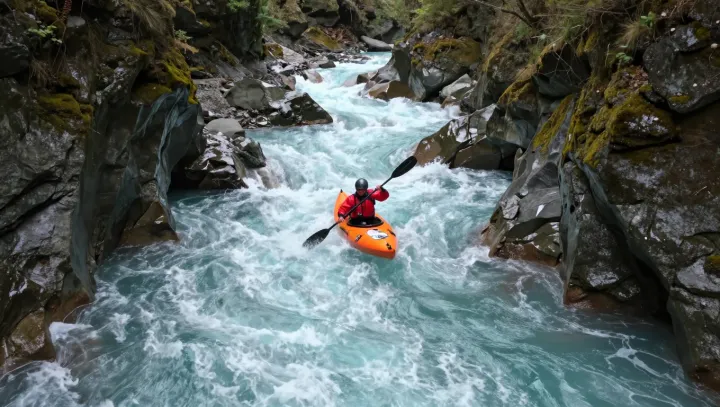
Whitewater looks like chaos; inside a kayaker’s head, the effect is closer to a system reboot. Spray explodes off the bow. Hull shudders on submerged rock. Every wave demands an instant choice.
The calm many paddlers describe is not soft serenity; it is forced selectivity. Cognitive scientists call it high perceptual load, a state in which sensory input is so dense that the brain allocates almost all processing to immediate demands, leaving little capacity for rumination. Under that pressure, the default mode network, the circuitry linked to mind wandering and self criticism, shows marked suppression in imaging studies of similar high focus sports.
Physiology adds a second filter. Rapid strokes drive heart rate and pulmonary ventilation, flooding blood with oxygen and increasing cerebral blood flow. At the same time, the hypothalamic pituitary adrenal axis releases stress hormones for short bursts, while reward pathways release dopamine and endorphins. That cocktail sharpens reaction speed and later produces the familiar afterglow: muscles spent, but mood lifted and pain blunted. What feels like tranquility is often the downshift that follows a controlled spike in arousal.
Attention training is the quieter reason kayakers step out of their boats feeling unusually clear. Repeated exposure to fast decisions in uncertain water appears to strengthen top down control networks in the prefrontal cortex, the same circuits recruited in mindfulness practice and cognitive behavioral therapy. Stroke after stroke, the paddler rehearses a simple loop: notice, decide, commit, then release the last move. By the time the boat slides into still water, that loop keeps running, only now it is applied to stray thoughts rather than standing waves.