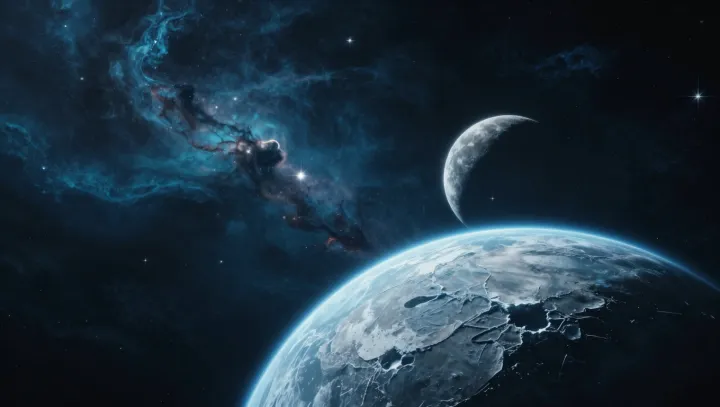
Blackness lies. Those iconic frames from orbit and deep‑sky observatories look empty only because human biology edits out almost everything that is actually there. Camera sensors pick up narrow bands of light; our eyes narrow that band even further; across most of the frame, the photon count drops below what your retina can register, so the detector’s rich signal collapses into a flat, silent dark.
The real scene is crowded. Interstellar medium, cosmic microwave background radiation, high‑energy cosmic rays and faint dwarf galaxies all pour through the same field, but most of that action sits outside the tiny optical window or arrives too weak for rods and cones to flag as presence. Astronomers stack exposures, apply false‑color mapping and run Fourier analysis just to tease structure out of what the raw image suggests is nothing at all.
The deeper sting, though, comes from psychology rather than physics. Human social wiring expects signals of life in any wide horizon; remove sound, scale and motion cues, and the brain tags the scene as isolation, not abundance. Space photos therefore stage a quiet trick: they show a crowded universe, then let your sensory limits strip it down to a single, echoing room.