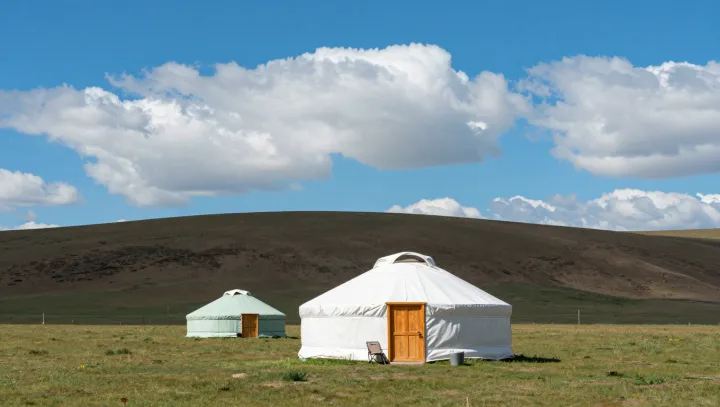
A round felt tent should fail in a killing blizzard. It does not. A yurt, built from a lattice of wooden poles and thick wool felt, works like vernacular climate engineering, turning minimal materials into a shelter that can face deep negative temperatures and gusts that strip heat from exposed skin in minutes.
The bold claim is simple. Shape is the secret weapon. The circular plan cuts external surface area, reducing conductive heat loss under Fourier’s law, while the low domed roof presents no flat face for wind pressure to attack. Airflow curves and slips, lowering uplift forces that would tear at a flat wall. No corners means no cold traps; interior air circulates smoothly, stabilizing convection and keeping temperature gradients small even when outside air can freeze water almost on contact.
Insulation, not bulk, finishes the job. Compressed wool felt traps air in countless microcavities, slowing thermal conduction and damping radiative loss, a biological material mimicking the logic of engineered fiberglass. Layered over a flexible wooden frame, it creates a continuous thermal envelope with almost no gaps, the weak point of many modern tents. A low smoke hole and door manage stack effect, letting hot air escape just enough to clear fumes while retaining most sensible heat. Collapsible, repairable, carried by animals, the yurt trades luxury for survivability and wins that bargain every time the wind rises.