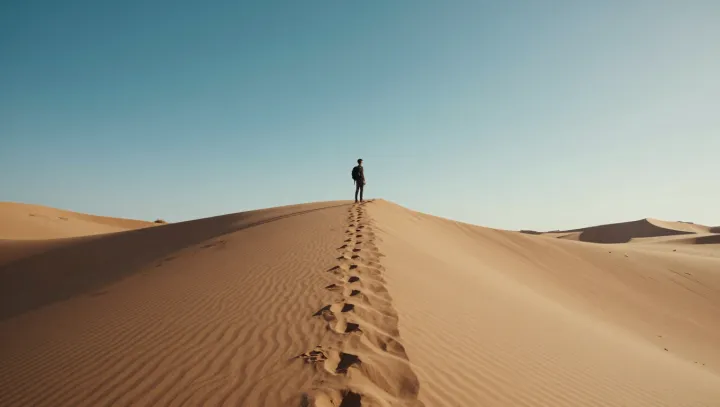
Empty horizon over the Tengger Desert looks like pure loss. Fewer tracks. Less support. Thinner margin. Yet the most deserted line can raise lifetime opportunity, because risk is not a single-shot lottery but a repeated series where variance and exposure dominate comfort. Pick the crowded route and you compress outcomes into a narrow band; pick the exposed one and you widen the distribution, which is where extreme upside hides.
The hard claim is this. Under repeated choice with feedback, expected payoff scales with variance when the downside is partly capped by preparation and technology. In decision theory this is exploiting convexity: when gains can grow superlinearly but losses hit floor constraints like survival gear, insurance or rescue logistics, higher volatility increases the average. The deserted line offers more information per kilometer, more signal about terrain, wind, equipment failure rates, and personal limits, which compounds into better Bayesian updating for every later expedition and for non-desert projects that reuse the same judgment muscles.
The bolder assertion is about path dependence. Early high-intensity choices act like strong gradients in stochastic optimization, yanking you out of mediocre local maxima that the safe caravan path quietly locks in. On the empty line you meet fewer competitors, so any discovered water source, passable dune corridor or sensor protocol becomes quasi property, an option you can leverage later. The statistical gain does not arise because danger is noble. It arises because structured, hedged exposure to the right danger rewires the entire tree of futures available to you.