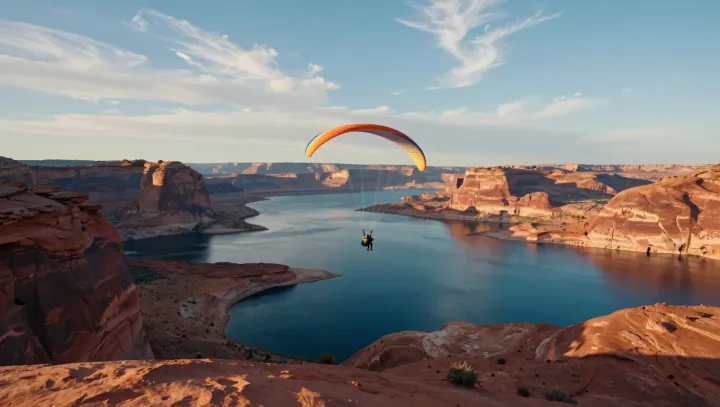
Rising air, not fabric or bravado, does the real work when a paraglider drifts across a canyon or lake. From the launch, the wing is already a glider with a fixed glide ratio, often around ten to one, which would doom any long crossing if the surrounding air were still and neutral.
The trick is that the air is rarely neutral; air itself climbs. Along a sunlit cliff or dark rock slope, solar heating drives atmospheric convection, creating thermal updrafts and ridge lift that move upward faster than the wing sinks. By turning tightly inside a thermal column, a pilot converts that vertical velocity into altitude, then glides on a shallow line toward the next source of lift, losing height through induced drag but spending it like currency.
This strategy sounds improvised, yet it is almost algorithmic. Pilots scan clouds for cumulus bases that mark condensation at the top of rising plumes, watch dust and birds as live probes of vertical velocity, and track vario instruments that translate pressure changes into audio cues. When a rising river of air spills up a cliff face and over a gap, a glider can surf that invisible flow, maintaining or even gaining height as the terrain drops away, until the opposite rim or distant shore slides within reach.