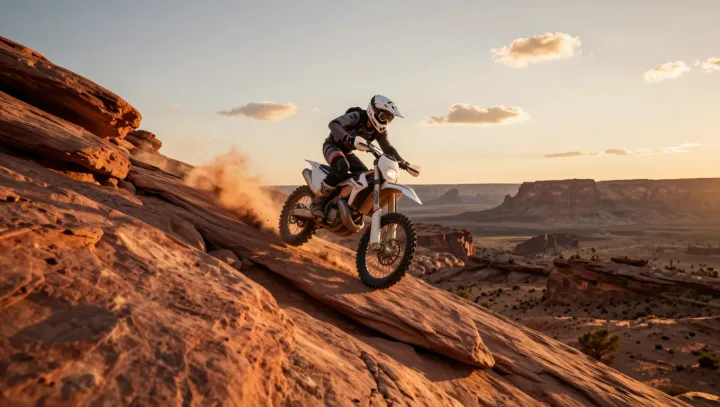
Dust is the first giveaway that desert dirt biking is really physics in disguise. Each rooster tail of sand marks an instant verdict on traction, as tire knobs test the friction coefficient between rubber and loose grit, then either hook up or shear away in a small avalanche of grains.
What looks like improvisation is closer to continuous problem‑solving, with riders acting as on‑board solvers of momentum and impulse, silently adjusting throttle and body position to keep the combined center of mass inside a narrow stability cone while the bike pitches, yaws and rolls across ruts and whoops that would throw a rigid system into chaos.
The bold claim is that most riders are doing vector math without numbers, because their nervous systems run a kind of analog kinematics engine, predicting how velocity, angular momentum and normal force will interact a heartbeat ahead, then encoding those predictions in tiny wrist inputs, micro‑braking and weight shifts that change load transfer across the axles.
Underrated in this quiet lesson is how the terrain itself becomes a chalkboard of micro‑features, where every ripple, embedded rock and soft patch rewrites the boundary conditions of the ride, forcing real‑time updates to lean angle and tire slip ratio as the bike surfs the edge between static and kinetic friction, proof that the class never really ends when the throttle stays open.