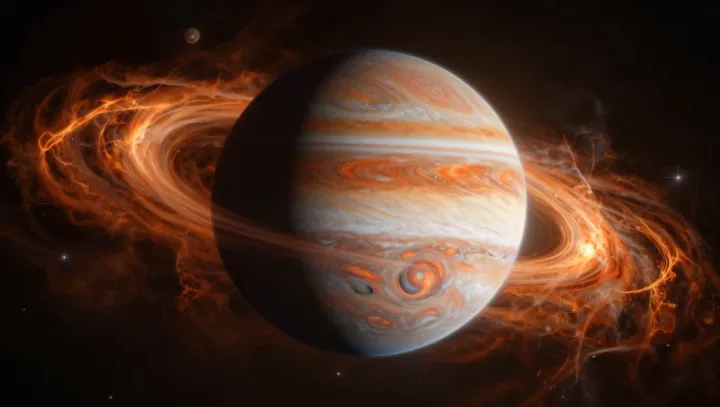
A gas giant makes Earth’s weather look timid. Where rock planets cap storms with solid ground and thin air, a deep hydrogen envelope turns wind into a three‑dimensional engine that can run almost without interruption.
The basic claim is blunt: a planet made only of gas is the best factory for a storm that never quite dies. With no surface to scrape away momentum, jets and vortices persist while they tap an enormous reservoir of potential energy. In the towering atmospheres of these worlds, convection and differential rotation feed off internal heat flux, so rising and sinking parcels of gas keep injecting energy into the same circulating structures instead of letting them decay into small, forgettable squalls.
Equally important is the way rotation locks these tempests in place. Rapid spin sharpens the Coriolis force, carving the atmosphere into zonal bands and helping large anticyclones stay coherent. Fluid dynamicists describe these as quasi‑two‑dimensional flows: motion stretches sideways far more than vertically, which suppresses the turbulent cascade that would shred a giant vortex on a smaller world. Trapped between jet streams and insulated by stratified layers, the storm effectively becomes a long‑lived feature of the planet’s general circulation rather than a passing piece of weather.
Scale finishes the job. On a huge sphere, with high gravity and thick gas, the Rossby deformation radius grows large, so a single vortex can span areas that, projected onto Earth, would swallow continents and keep spinning long after human lifetimes have come and gone.