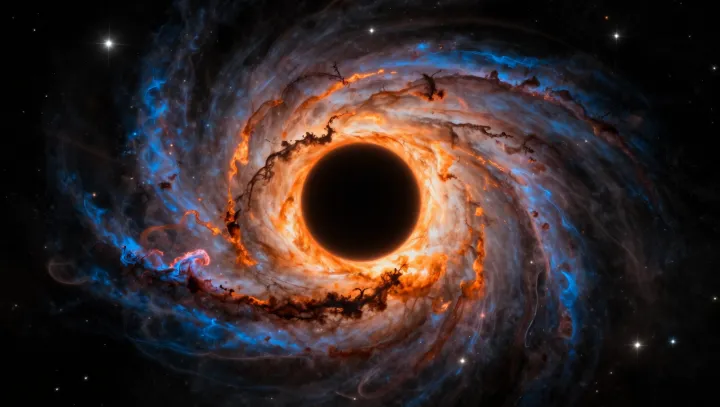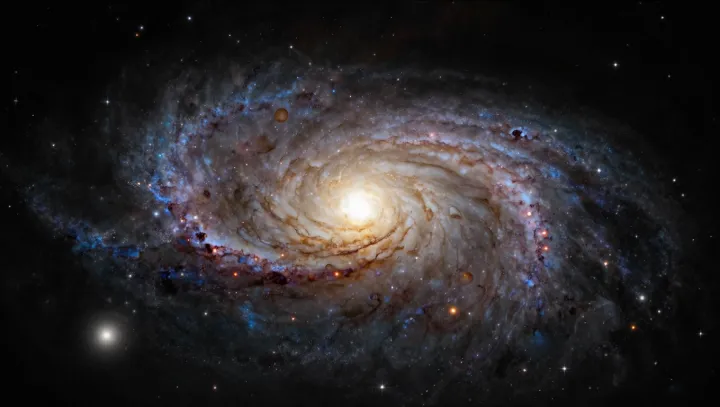
The strangest fact about a giant spiral galaxy is not its size but its near-nothingness. A disk can stretch more than one hundred thousand light‑years, pack in hundreds of billions of stars, and still, on average, contain less matter than the best vacuum chamber built by engineers.
Space between stars is not dense. It is the interstellar medium, a mix of gas and dust. Typical regions hold roughly one hydrogen atom per cubic centimeter, sometimes far less. High‑grade laboratory vacuum pushes that number down, yet over galactic scales the average remains even lower, because vast volumes are almost bare.
This emptiness is not an accident. Gravity, described by general relativity, pulls matter into knots and filaments, leaving large cavities in between. Stars are compact. Each is a tiny point compared with its orbital distance. If a star were the size of a grain of sand, its nearest neighbor might still sit kilometers away. Collisions are rare. Orbits rule.
Density hides in small places. Planetary systems, molecular clouds, and stellar cores hold nearly all the mass, while most of a galactic disk is thin plasma. Even the dark matter halo, inferred from rotation curves, adds gravity with almost no particles per unit volume. So the bright band of a galaxy is less a crowded city and more a faint mist in a colossal void.