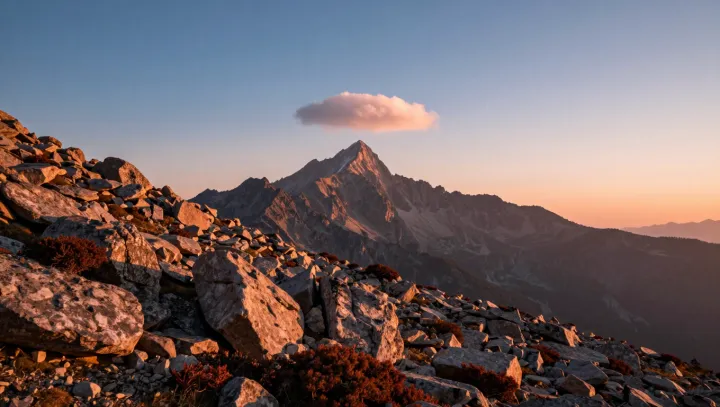
Light is far less loyal to scale than it looks. A cloud only a few hundred meters wide can, once it drifts into the solar beam near sunset, act as a moving optical gate that controls which wavelengths reach a mountain range stretching across many kilometers. In that low-angle geometry, the Sun’s rays travel through a long column of air, already filtered by Rayleigh scattering and aerosol extinction, so a small change in where those rays are blocked or redirected propagates across an enormous ground footprint.
The real shock is how organized the physics is behind what feels like a mood swing in the sky. As the cloud intersects the direct beam, its upper edges forward-scatter warm, long-wavelength light into hazy air above the peaks, enhancing Mie scattering and throwing amber and magenta glows onto distant rock faces that never see the Sun itself. At the same time, the dense core of the cloud casts a penumbra and umbra that slide over ridges, steepening luminance gradients so valleys drop into near-black while snowfields flare with high contrast. Human visual perception, wired for edge detection and relative brightness, exaggerates this shift; the mountains do not change, but the radiative transfer field around them is rewritten. When the cloud moves on, the entire scene snaps back, as if a vast dimmer switch had been tied to a passing puff of vapor.
The unsettling part is scale mismatch. A feature smaller than a town can, through geometry and scattering physics, command the appearance of terrain larger than some countries, reminding observers that the mountain range is visually at the mercy of whatever drifts through that narrow corridor of evening light.