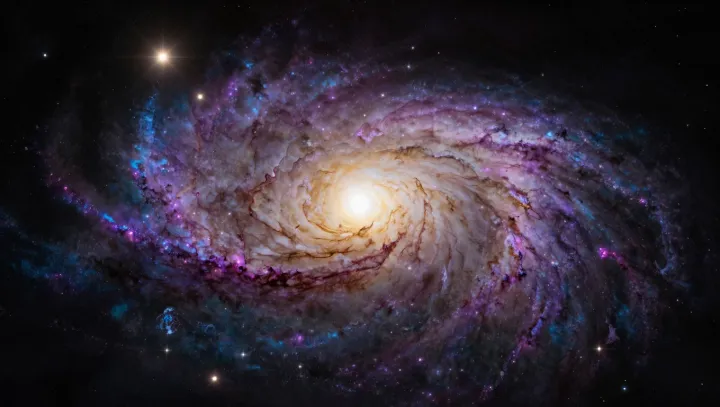
A nebula cheats your intuition. Space holds almost nothing, yet the sky shows a glowing sheet of color where the interstellar medium barely exists as a gas. What you see is not density. It is accumulated light along an absurdly long path.
The key is scale, not substance. A typical emission nebula may have only a few hundred atoms per cubic centimeter, a far lower number density than an ultra‑high‑vacuum chamber, but that thin gas extends for trillions of kilometers, so every meter adds a tiny increment of photon emission to the beam that reaches your eye. Radiative recombination and collisional excitation in hydrogen and oxygen pump out specific emission lines, so even a small emissivity integrated over such a vast column becomes visible against the dark sky.
Color is another trick, not of saturation but of selectivity. Ionized hydrogen flashes in the H‑alpha line, while doubly ionized oxygen radiates in narrow green‑blue lines; those discrete quantum transitions carve out the familiar palette without needing a thick fog of atoms. Interstellar dust then scatters and absorbs some wavelengths, reshaping the spectrum and softening edges so the structure looks like a veil rather than a wireframe. The eye, integrating photons over time and area, finishes the illusion.