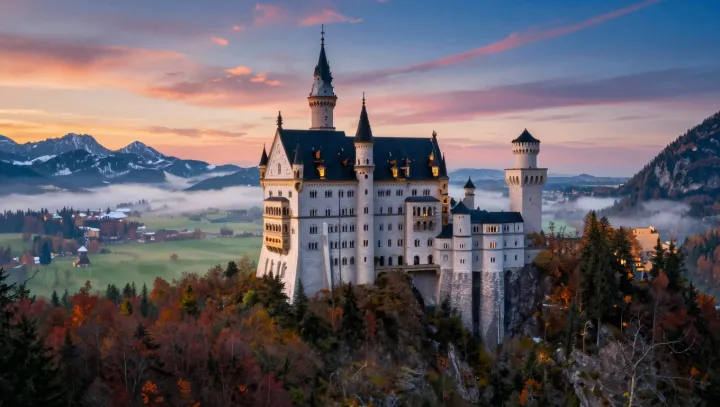
Sheer rock, not romance, is the real architect here. Perched on a crag, the castle sits where gravity does most of the fighting, forcing enemy siege engines into narrow arcs and dead angles that military engineers once calculated with the same care they gave to wall thickness or mortar mix ratios.
What looks like pure fantasy art direction is actually ruthless logistics. High ground shortens watch lines, cuts guard numbers, and turns every approach into a kill zone shaped by basic projectile motion and primitive ballistics, while steep slopes reduce the length and cost of curtain walls, saving stone, lime, and labor in a world where hauling each block was a budget line, not a legend.
The fairy‑tale profile is also an accounting decision in stone. Later owners kept the towering keeps, needle‑thin turrets, and dramatic voids because tourists paid for silhouettes, not for historically tidy floor plans; tourism economics rewarded photogenic verticality, so restorers doubled down on sky‑line drama instead of reconstructing messy service yards or squat, efficient barracks.
So the castle stands, less a portal to another world than a joint venture between gravity and revenue, its fantasy aura just a side effect of old siege math and modern ticket sales.