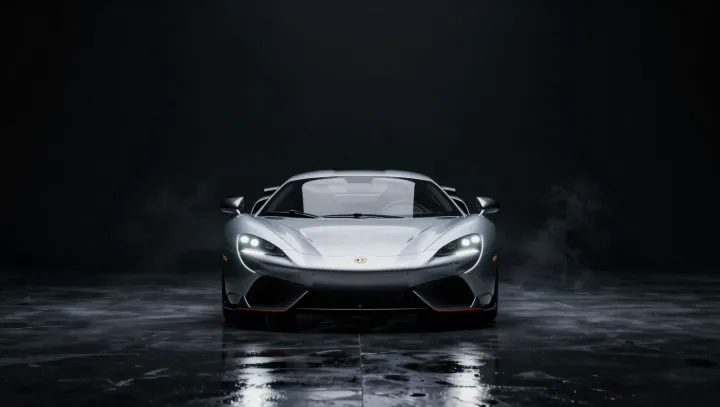
Those thin LED strips owe more to a stealth jet than to a fashion sketch. In the dark, a modern supercar front is not just styled; it is engineered as a controlled signal on a black canvas, the way a radar cross-section is engineered as a controlled echo in hostile airspace.
The bold claim is this: menace is a by-product of signature management. Stealth aircraft use facet alignment and planform shaping to bounce radio waves away from the receiver, cutting apparent size. Car designers flip that logic. They align creases, grille edges and intake surrounds so reflections converge toward the viewer. High-contrast chamfers act like specular mirrors, guiding a few photons from LED sources along carefully modelled surfaces while leaving adjacent planes in deep shadow.
Even the “angry” light graphic is an optical cousin of a radar antenna lobe. Engineers run ray-tracing and bidirectional reflectance distribution function models, then carve out light guides and shrouds that collimate the beam into sharp signatures. By recessing the modules and overhanging the hood, they occlude the upper part of the lamp, creating a squint that the brain reads as predatory, though it is simply occlusion geometry and luminance contrast at work.
The darker trick is how mass is edited away. Where stealth jets hide their engine faces behind S-shaped ducts, supercars hide visual bulk behind negative surfaces and shadow gaps. Air intakes are pulled outward and framed by knife edges so the center section visually recedes, like a fuselage blended into a wing. Under sparse LEDs, the eye only sees the lit rims and sharp intersections, so the car feels narrower, lower, more intent, even though the hard points have barely moved on the engineering drawing.