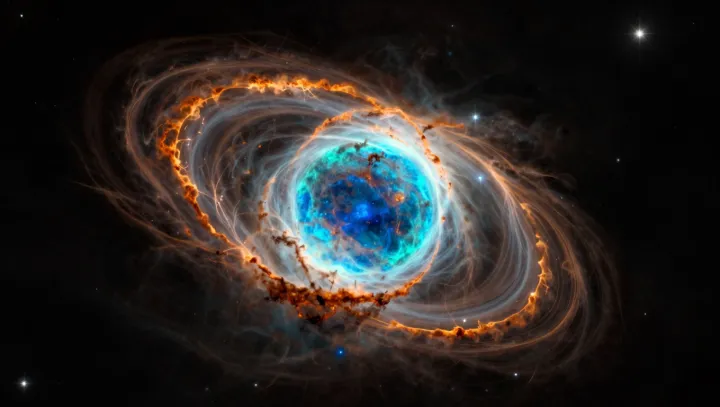
That glowing cosmic eye is not gentle at all. Around the faint center, gas tens of trillions of kilometers wide shines because it is being bombarded by invisible ultraviolet radiation from a corpse star no bigger than Earth yet far hotter at its surface than most active stars. Compressed into a white dwarf, the exposed core packs roughly solar mass into a volume similar to our planet, forcing gravity and pressure into an extreme compact configuration that keeps the surface fiercely hot while the interior cools only slowly through photon diffusion.
The harsh secret is temperature, not size. At surface temperatures of tens of thousands of kelvin, the white dwarf’s blackbody spectrum peaks in the ultraviolet, and those high energy photons carry enough punch to ionize atoms of hydrogen, oxygen and nitrogen in the surrounding planetary nebula. Short wave ultraviolet light strips electrons, turning the gas into a plasma, and when those electrons recombine with ions they emit visible emission lines that sketch out rings, filaments and the eerie iris-like glow captured in telescope images.
Power beats scale in this regime. Because the white dwarf radiates like a compact furnace with luminosity comparable to or exceeding that of many full-sized stars, each square meter of its tiny surface launches an intense ultraviolet flux into space, and that flux spreads across the expanding shell of gas, maintaining ionization over distances that sound absurd for such a small source until you remember that vacuum barely absorbs any of that light at all.