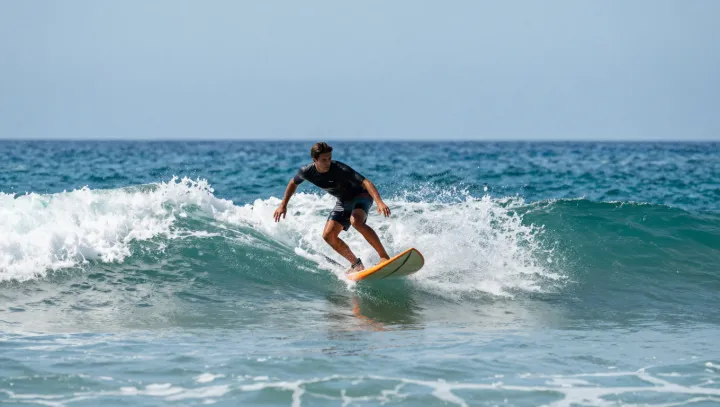
Whitewater makes more sense to a trained bodyboarder than a busy street makes to an office worker. That sounds backwards, yet sensory science quietly supports it. Under pressure, the brain does not add noise; it prunes it. Sports psychologists call this perceptual narrowing, and it lets a rider discard sky, beach, crowds and fix on lip, section, and exit line in a single compressed frame.
Flow is not a buzzword here; it is a survival filter. When a set rears up, the autonomic nervous system spikes heart rate and cortisol, but repeated immersion teaches the prefrontal cortex to quiet and hand control to sensorimotor circuits. Reaction time drops, working memory load shrinks, and the rider stops “thinking” in sentences, responding instead through procedural memory encoded in the cerebellum and basal ganglia.
The real trick is that focus becomes physical, not philosophical. Long hours staring at shifting peaks tune the visual cortex to micro-patterns of texture, refraction, and period, in much the same way expert radiologists see anomalies in noisy scans. On land, mild overload scatters attention because nothing punishes a missed cue; in heavy surf, every missed cue is corrected by impact, and the wave, merciless tutor that it is, edits the brain until only signal remains.