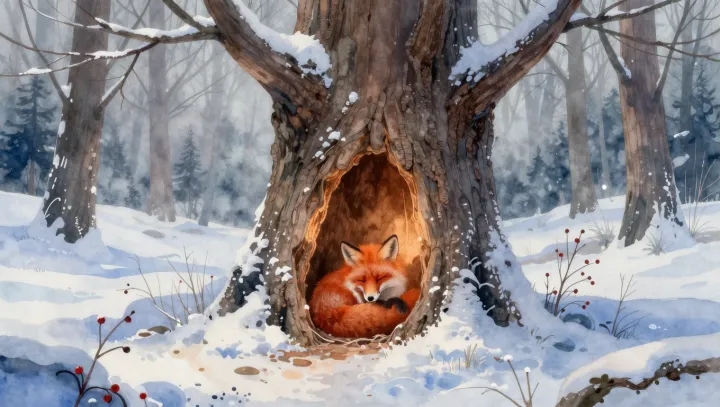
Snow-muted stillness wins the memory race. A fox curled in a hollow offers the brain something fireworks rarely do: stable input that attention can hold, emotion can soften, and the hippocampus can methodically encode into long-term storage.
This bias is not poetic; it is resource management. The visual cortex and parietal attention networks cannot sample fine detail when light blasts, color shifts, and sudden booms force rapid orienting responses. Fireworks push the amygdala into brief threat evaluation and keep the locus coeruleus pumping noradrenaline, which sharpens vigilance but fragments the continuous signal the hippocampus needs for robust episodic encoding.
By contrast, the quiet fox is cheap to monitor and rich to record. With no urgent threat, the prefrontal cortex can sustain focused attention on fur texture, breath clouds, and the contour of the hollow, giving the hippocampus time to run pattern separation and synaptic consolidation instead of firefighting. Parasympathetic tone rises, heart rate steadies, and neuromodulators slide toward a profile that favors plasticity over alarm. The scene becomes not just seen but mapped into relational memory: fox against snow, curve against shadow, safety against cold air.
So the brain, built for survival, makes a counterintuitive choice. It lets the noisy spectacle pass as a surveillance task and spends its limited encoding budget on the safe, slow frame where it can afford detail, context, and narrative.