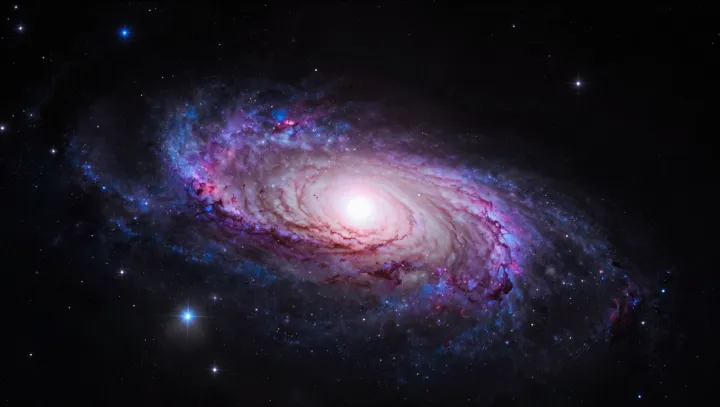
Those graceful spiral disks are lying to you. A spiral galaxy is not a flat ornament but a rotating three dimensional storm of stars and gas, with material racing around the center at hundreds of kilometers per second in the galactic plane and bobbing above and below it in a thick, dynamic disk.
The real shock is that gravity from visible matter alone cannot hold this system together at those speeds. Measured rotation curves stay almost flat far from the center, where starlight thins out, yet the orbital velocity barely drops. Newtonian dynamics says something unseen must deepen the gravitational potential, so astrophysicists infer extended dark matter halos enveloping the luminous disk and setting the safe speed limit.
Equally underappreciated is how ordered this chaos is. Stars follow near circular orbits that trade kinetic energy against gravitational potential energy, so they do not need extra support to avoid collapse, and do not escape unless given a strong kick. Spiral arms are not rigid structures but density waves, described by galactic dynamics and differential rotation, that crowd stars and gas without dragging them outward like solid blades. Seen from afar, the whole arrangement looks fragile. In phase space, it is a remarkably stable machine.