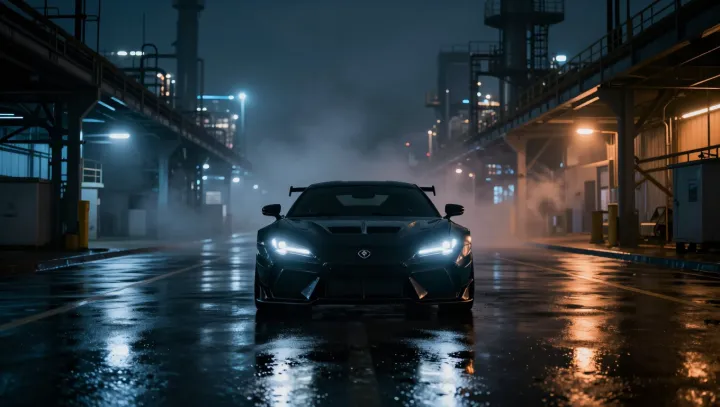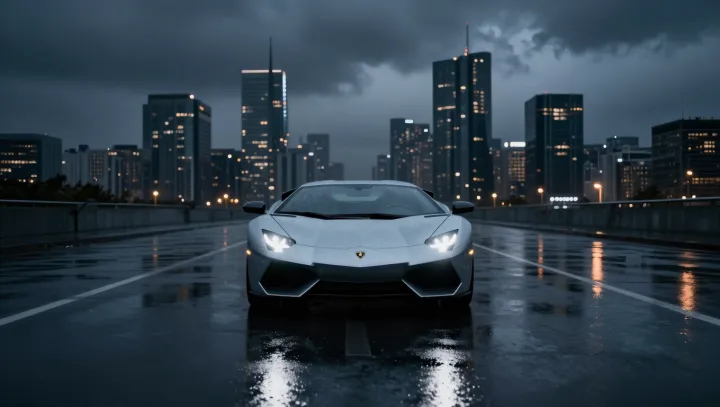
Storm-dark asphalt does the styling, not the badge. Under heavy clouds, the wet road behaves like a giant horizontal screen, bouncing light back toward your eyes and exaggerating every contour of a low car. The scene stops being just car-on-road; it becomes object plus reflection, a stacked image that your visual system reads as more intense.
The blunt truth is that rain gives the car extra geometry. On dry pavement, luminance contrast between bodywork and ground is limited by the matte, scattering surface. Add a thin water film and you create specular reflection, so every headlamp, taillight and streetlamp is cloned beneath the chassis. Short edges become long axes. The silhouette stretches. Your brain uses edge detection in the primary visual cortex to lock onto these repeated lines, boosting perceived sharpness and presence.
Dark clouds help even more. They push the scene into high dynamic range by dimming the sky while local light sources stay bright. The car now sits between a low, brooding ceiling and a glossy floor that acts like a contrast amplifier. You are not just seeing a machine; you are seeing a feedback loop of light, reflection and neural processing, all conspiring to make that already low supercar look lower, louder, and almost unreal.