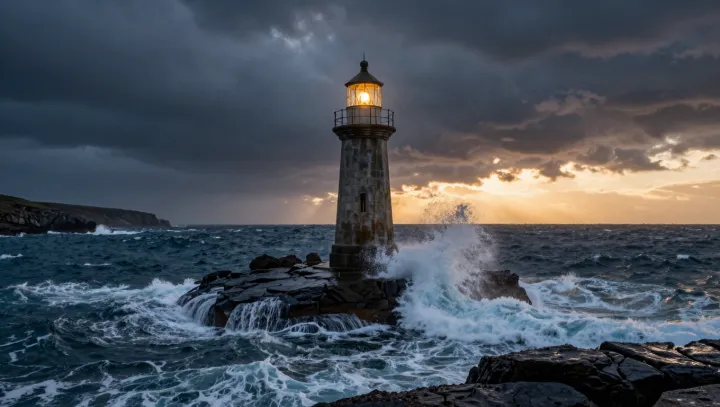
Raw impact, not graceful beauty, defines a lighthouse on an exposed rock. Storm waves slam the tower with pressures comparable to a vehicle hitting a rigid barrier, yet the lantern keeps burning and the glass stays intact. That resilience starts below the waterline, where engineers extend the masonry or reinforced concrete deep into the rock, creating a monolithic foundation that spreads dynamic loads and limits differential movement.
The real surprise is that the tower does not try to resist every hit by sheer rigidity. It accepts controlled motion. Tapered walls, stepped profiles, and curved seaward faces shed water, turning a direct blow into sliding flow, which reduces peak hydrodynamic pressure. Structural engineers model this with wave loading and stress distribution analysis, then specify dense stone courses, interlocking blocks, and stainless or phosphor bronze anchors that tie the tower to the bedrock as a single structural system.
Light stability is not left to chance either. The lantern sits above the tower’s neutral axis, on a stiff internal frame isolated from the outer shell by vibration‑damping details. The Fresnel lens assembly, once driven by clockwork and now often by electric motors and LED arrays, rotates on precision bearings that tolerate minor tilting without seizing. Toughened glass panes, metal mullions, and redundant sealing keep spray and wind out, so even when the structure shudders like a struck bridge deck, the optical system keeps delivering a steady signal to ships in the dark.