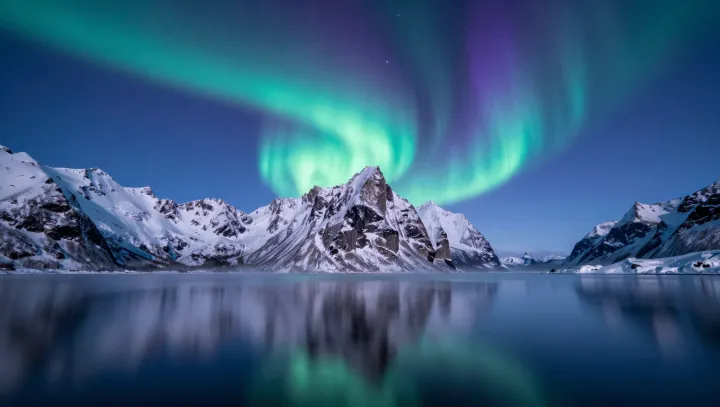
Those glowing rings are not free to wander. They are pinned to space by geometry as strict as any engineer’s drawing, where invisible magnetic lines intersect a fragile shell of air high above the planet.
At work is a hard constraint. Earth’s dipole magnetic field funnels charged particles from the solar wind along field lines into oval zones around each pole, a structure physicists call the auroral oval. These lines thread the atmosphere at specific altitudes. Too low, and dense air absorbs incoming electrons before they can excite atoms. Too high, and there are too few atoms to light up. The result is a sweet spot, typically between one hundred and three hundred kilometers, where collisions between fast electrons and atmospheric oxygen and nitrogen most efficiently produce emission lines in green and red.
More surprising is how ring-like this becomes. Because the magnetosphere guides particles along entire bundles of field lines, not along a single track, the impact zone forms a vast, closed loop encircling each polar region. Ground observers see shifting curtains, but from orbit the structure resolves into near-continuous ovals locked to magnetic latitude, not to coastlines or continents. The altitude band stays narrow because both atmospheric scale height and particle energy spectra cooperate: change either, and brightness quickly falls off. No road can lead there; that luminous ring is a moving contour in plasma physics, not a place a person could ever stand.