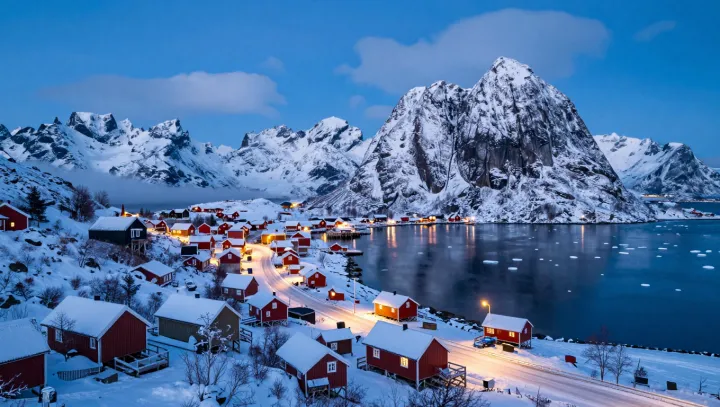
Warm air should not belong to a tiny Arctic town, yet the thermometer often says otherwise. Around a tight cluster of low buildings and sodium street lamps, air near the ground can sit several degrees above the open tundra, a pocket of comfort stitched directly into polar night.
This is not magic; it is ruthless geometry. Packed walls and narrow alleys shrink exposure, cutting convective heat loss the way a thermos narrows its neck to slow fluid cooling, a direct play on boundary layer physics. Low, dense blocks interrupt katabatic winds that would otherwise flush warm air away, while snow piled against facades acts as extra insulation with very low thermal conductivity. The result is slower heat flux from human interiors to the sky.
Streetlights, windows, and signage then do something bolder: they rewrite local radiative transfer. Every bulb and pane throws out shortwave and longwave radiation that is repeatedly absorbed and re-emitted by nearby surfaces, a feedback loop that thickens the nocturnal inversion layer just above the town. Dark roofs and asphalt push the effect further by storing daytime gains and bleeding them out after dusk. What looks like simple winter lighting is, in practice, a continuous low-power heater wrapped in architecture.
So a scattered camp loses its warmth to the horizon, yet a compact grid holds onto it, glowing against the surrounding ice like a small, stubborn climate of its own.