Galactic motion looks wrong. Space itself behaves like it got the equations slightly miscopied. From that unease comes the bold claim that about ninety five percent of the cosmos is invisible stuff: dark matter plus dark energy.
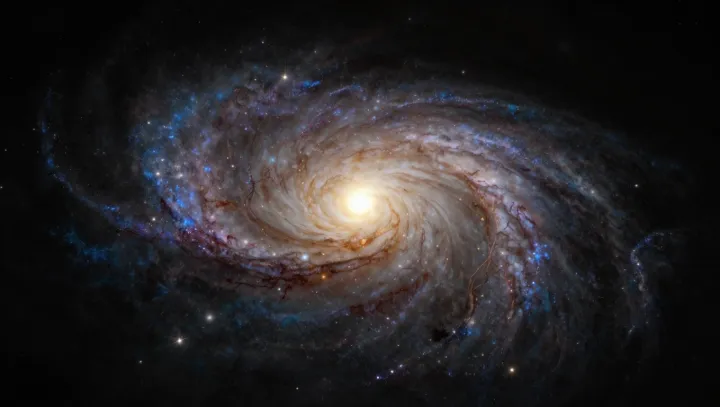
The uncomfortable fact is simple. Stars in spiral galaxies orbit too fast in the outer regions, yet the visible mass is too small to generate the required gravitational potential. Newtonian dynamics and general relativity are clear on this point, so either gravity changes on galactic scales or extra mass lurks there. Halo models using cold dark matter reproduce flat rotation curves and gravitational lensing patterns with one parameter set, across many systems.
Even more radical is the claim about dark energy. Observed distances to Type Ia supernovae, combined with redshift data, show accelerated expansion instead of the expected slowdown from gravity. When those measurements are folded together with the cosmic microwave background power spectrum and baryon acoustic oscillations, a consistent fit emerges only if a smooth component with negative pressure dominates the energy density.
So this is not an aesthetic choice. One framework, the Lambda cold dark matter model, matches galaxy clustering statistics, the acoustic peaks in the microwave background, and the inferred age and size of the observable universe with a single set of density parameters. Modified gravity ideas exist, but they struggle to hit all these targets at once without new hidden pieces of their own.