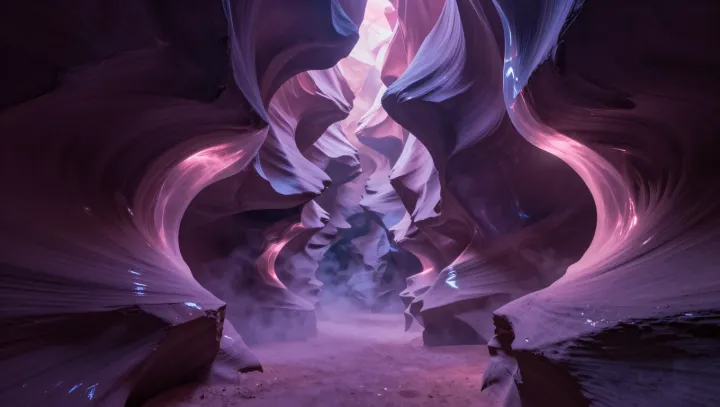
Pink light in a dark cave is less magic than misdirection. The ice is not a neat glass wedge; it is a chaotic optical device that still obeys Snell’s law and dispersion. When daylight seeps through the entrance, it hits layered ice with bands of different density, trapped air, and mineral dust. Each boundary bends and splits the incoming spectrum by refractive index, sending slightly different colors along slightly different paths.
The surprise is how stubborn that pink can look. Shorter wavelengths scatter strongly off microscopic bubbles and dust, a process close to Mie scattering rather than simple Rayleigh scattering, so blue and green get sprayed sideways and lost into the cave walls. Longer red wavelengths, less perturbed, propagate deeper through the ice matrix. Over distance, selective absorption trims away what little blue survives; impurities inside the crystal lattice soak up parts of the spectrum unevenly, leaving a biased remainder that the eye reads as pink.
Prism behavior here is messy yet effective. Individual ice facets act like tiny dispersive prisms, but they are misaligned, fractured, and sometimes partially melted, so you get overlapping shafts and faint halos instead of a clean rainbow bar. Geometry finishes the job. A narrow entrance, pale rock, and a floor of translucent ice create a light trap where scattered red dominates the visual field. What looks like a colored lamp is only daylight, filtered by frozen disorder.