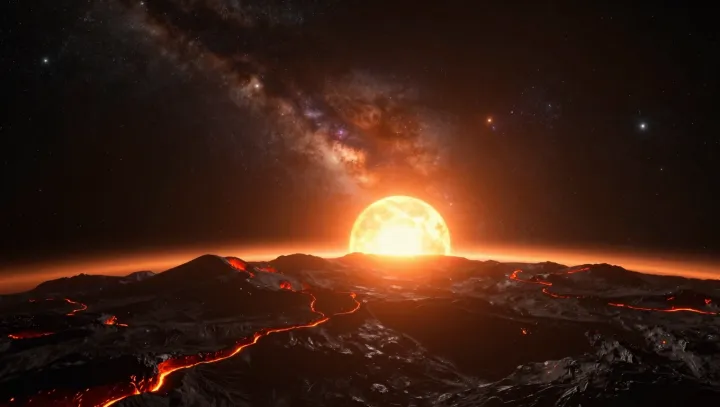
A rocky world can get absurdly close before it dies. Close enough that its nightside shines a dull red, while the dayside approaches the incandescent heat of industrial furnaces and the crust behaves more like a fractured slag than solid ground. At this range, intense stellar radiation and tidal forcing cooperate, driving surface temperatures to the regime where silicate rock softens and partial melting begins, yet the bulk planet remains gravitationally intact and does not disintegrate into a vapor plume.
The harsh truth is that gravity sets a stricter line than heat. Cross the Roche limit and differential gravity tears a planet into a debris stream, but stay just outside and the body survives, even as tidal heating and thermal stress open global fissures. Observed ultra short period planets, some orbiting in less than a standard workday, show densities consistent with compressed rock and iron, suggesting that mass loss by thermal escape and sputtering is fierce yet not fast enough to erase the planet on human timescales.
The more counterintuitive limit is thermal, not mechanical. A rocky surface can endure temperatures above the melting point of many silicates, forming a magma ocean that convects like a churning pot, while vaporized minerals create a thin, metal rich atmosphere that constantly escapes to space. As long as the energy input does not exceed the rate at which the planet radiates and sheds mass, the object persists as a stable, if shrinking, world: cracked, glowing, but still a planet and not a cloud.