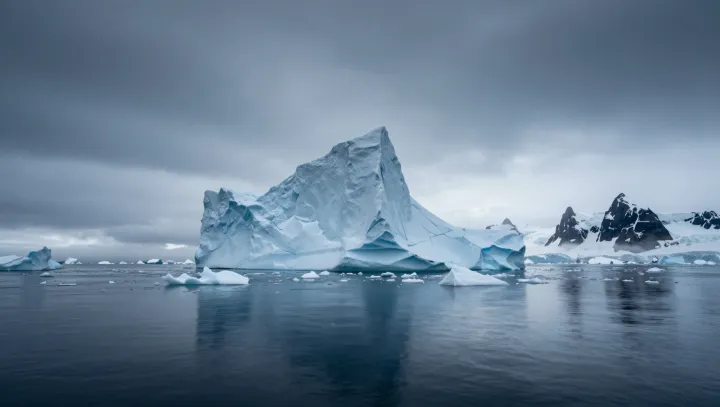
An iceberg looks deceptively modest. Beneath that modest profile, basic physics gives it a hidden bulk that borders on absurd. Ice has a density only slightly lower than seawater, so Archimedes’ principle forces about nine tenths of its volume below the surface, the submerged ice displacing water until weight and buoyant force balance in a quiet, relentless equation.
More surprising is how noisy the exposed fraction really is. Wind shear, wave impact, and differential ablation continually attack the above-water ice, exploiting tiny fractures and grain boundaries, then widening them through freeze–thaw cycles and brine drainage. From this slow violence rise narrow fins, fluted ridges, and spires that resemble ruined cathedrals, each contour reflecting local wind fields, storm tracks, and sea-surface temperature gradients over its short life.
The popular image of a still, eternal berg is wrong. These structures are dynamic archives. Radiative heat flux darkens and undercuts some faces, while turbulent mixing and latent heat exchange gnaw at the waterline from below, shifting the iceberg’s center of mass until it can suddenly roll, exposing fresh ice and resetting the sculpting process. Locked into those sharp blue buttresses is a physical logbook of the polar ocean: how warm the water ran, how salty the brine, how fierce the storms that passed overhead.