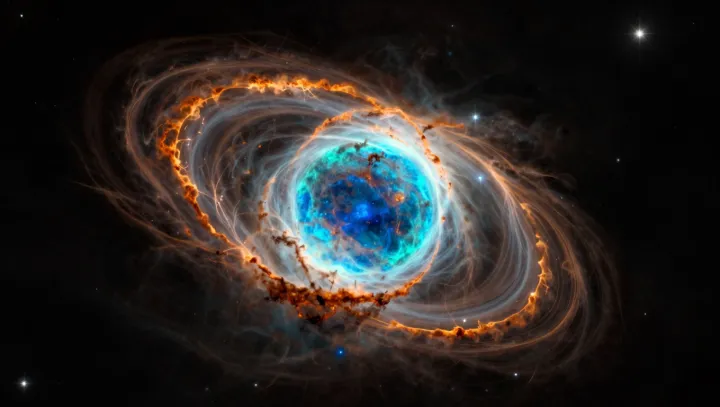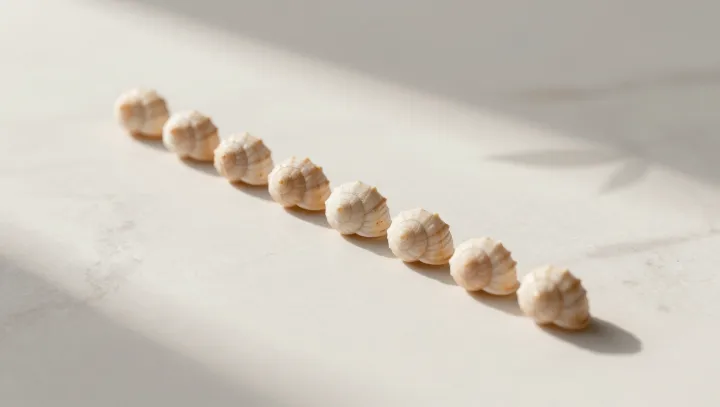
A seashell does not “aim” for elegance; it is trapped by geometry. At the growing lip, a thin band of mantle tissue adds calcium carbonate in tiny, repeated increments, and when that deposition rate stays roughly constant while the animal itself expands, the only stable outcome is a logarithmic spiral whose shape does not change as it scales.
That spiral, far from mystical, is an artifact of growth mechanics. Differential growth along the shell lip, coupled with near-constant angular expansion, yields a curve with geometric similarity, the same mathematical property engineers exploit in helical ramps, turbine housings and stress-dispersing arches. Small mutations that altered protein secretion, mineral nucleation or curvature of the mantle edge nudged early shells away from this pattern, yet those deviations often produced forms that cracked more easily or wasted material, so natural selection kept favoring the self-similar spiral.
Architects now borrow back what mollusks converged on by trial and error. The logarithmic spiral and its close cousin, the equiangular spiral, offer predictable stress distribution and efficient surface increase without changing overall form, a principle mirrored in load paths of domes and ramps in dense urban structures. On rocky coasts and in design studios alike, the same compact rule set quietly governs who endures and what collapses.