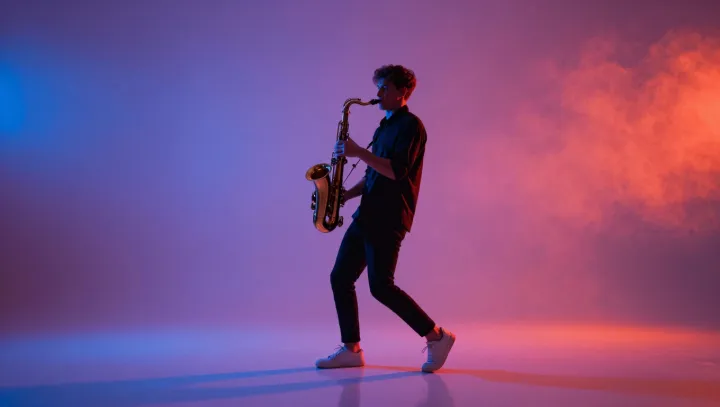
Power in music is not only in the notes; it is in the body that seems to launch them. The same sax solo, replayed without a single altered frequency, can be rated as stronger when a performer plants their feet wide and stands under red light, because the brain fuses sight and sound into one judgment.
What feels like pure hearing is, in practice, a multisensory integration problem. Visual posture cues feed into motor cortex and premotor cortex, activating internal models of force and effort, so a grounded stance is read as higher exertion, then misattributed to the sound. Short phrase. Red light compounds the effect: studies on color psychology and autonomic arousal show that longer-wavelength light can raise heart rate and skin conductance, shifting listeners toward a high-intensity state before a single note is processed in the auditory cortex.
The surprise is that the waveform at the microphone can remain identical while the rating scales on listener questionnaires jump. Briefly. To perception scientists this is classic embodied cognition, in which posture, color, and spatial framing bias loudness and energy judgments through top-down modulation of sensory gain. The sax solo does not grow; the listener’s internal amplifier does, quietly rewired by stance and light.