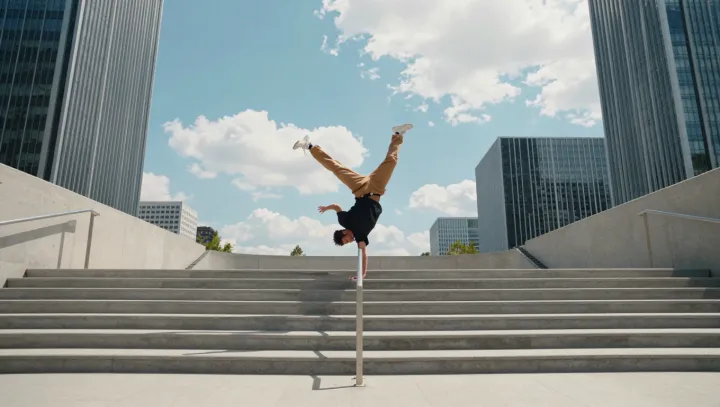
Light hits a pale concrete wall, and something in the body flinches. Not because of color. Because the eye is forced into high-contrast work as shadows knife across sharp edges, loading the visual cortex with clear signals about depth, boundary and risk.
Architects quietly bet that muted palettes are not neutral at all; they amplify every small spatial decision. When chroma drops, luminance and contrast ratios take over, so a one-degree tilt in a ceiling plane or a slightly narrowed corridor suddenly becomes legible to depth perception systems that rely on binocular disparity and edge detection. A gray stair, cut by a single slot of daylight, drives the amygdala harder than a rainbow lobby, because the brain reads that vertical shaft of light as both path and threshold, a subtle cue about safety, exposure and social performance.
More provocative is how nearly colorless spaces hijack time. Without bright surfaces to grab attention, the eye lingers on slow gradients of penumbra, on the way indirect illumination softens a corner, on the crisp occlusion where one slab eclipses another. That sustained gaze lets spatial memory and proprioception sync, so a corridor can feel like a compressed lung and a double-height void like a held breath. Here mood is not painted on; it is engineered through geometry, luminance, and shadow density, until the quietest room feels louder than any saturated mural.