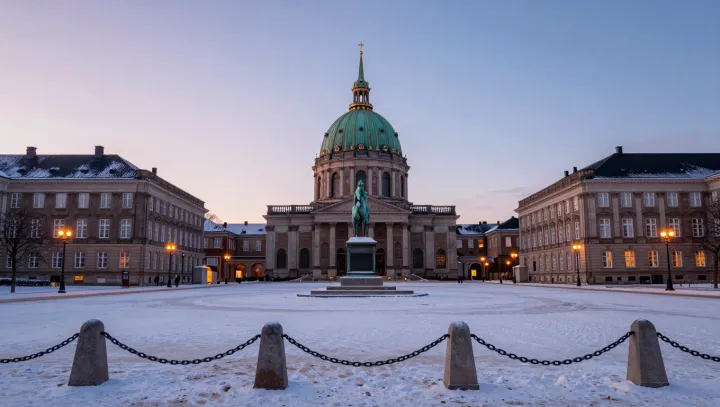
Cold light does not always chill people. On Amalienborg Palace Square in Copenhagen, the pale sky and hard shadows soften a space once calibrated for royal display. The octagonal plan, the radial streets, the four near-identical palaces were meant to stage rank, distance and surveillance across an exposed gravel void.
Yet comfort thrives here. Strict bilateral symmetry, usually blamed for intimidation, strips the square of visual noise, so the eye rests and the nervous system follows. With no dense street furniture and no retail frontage, social expectation drops; there is nothing to buy, nowhere to perform. People sit on the low edges, lean against the equestrian statue, or simply stand in the open, shielded by anonymity rather than walls.
The geometry quietly regulates movement. Axial sightlines manage crowd flow the way a well-designed circulation plan manages air, reducing friction between tourists, locals and ceremonial guards. In the cold season, the high albedo of stone and gravel bounces limited daylight back onto faces, a primitive form of environmental design that softens the psychological weight of long dim days. Power still frames the scene, but the square’s emptiness now works like a generous pause in speech, giving visitors room to breathe inside the old script.