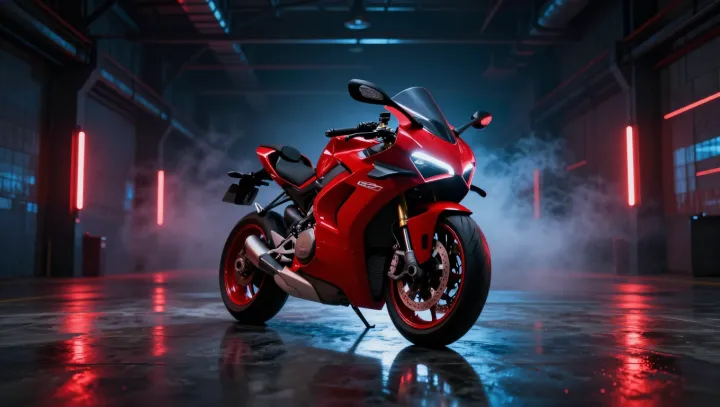
That tiny dark oval under a sportbike is not fragile at all. It is the most efficient compromise physics will allow between grip, stability and speed on hard ground, even when that ground is slick concrete filmed with water. Squeezed by the bike’s weight, the tire carcass deforms elastically, spreading force until the internal air pressure and the external load reach equilibrium, so the bike does not sink because the pressure in the contact patch simply matches the pressure inside the tire.
The real surprise is not support but grip. Friction here is less about stickiness and more about contact mechanics and shear. Rubber is viscoelastic, so its surface flows microscopically into the floor’s roughness, then resists being dragged back out; that hysteresis loss converts motion into heat and creates resistance to sliding. Water seems like the enemy, yet the soft tread and grooves act as a hydrodynamic pump, expelling fluid so rubber still touches asperities instead of surfing on a full lubricating film.
What looks like risky minimalism is actually redundancy at microscopic scale. Within that palm-sized zone, countless micro-contacts are born and die each instant as the tire flexes, each obeying Coulomb friction and stress distribution rules that have been measured in tribology labs for decades. The bike stands still not because the patch is large, but because every square millimeter is working at near-optimal load.