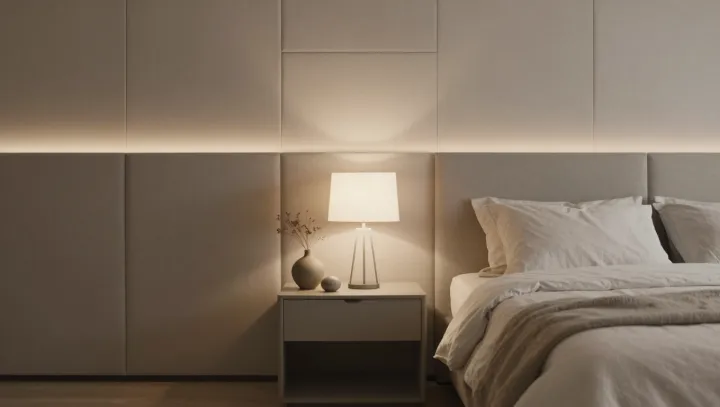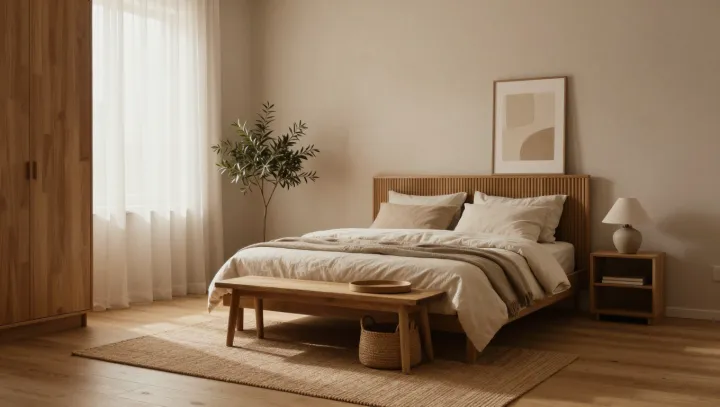
The beige bedroom is not boring. It is a controlled experiment in atmospheric optics that just happens to contain a mattress and a nightstand, and its most dramatic variable is the angle at which sunlight slices across the sky. At a high solar angle, short wavelengths dominate the diffuse component of daylight, Rayleigh scattering floods the room with a relatively cool, blue-weighted spectrum, and every beige surface collapses into a single, flat register.
By late afternoon, the physics flips. Lower solar elevation forces sunlight through a longer optical path, selectively attenuating blue and allowing longer red and orange wavelengths to survive, which shifts correlated color temperature downward and exaggerates contrast along edges and textures. Now the sheer curtains stop behaving like neutral decor and start functioning as a spectral filter and diffuser, softening direct irradiance while biasing the transmitted light toward that amber band your brain associates with hotel lobbies and high-thread-count sheets.
So the room does not become warmer because anything inside it has changed. Your visual cortex is simply reweighting signals as the incident spectrum, scattering geometry, and luminance ratios slide from midday uniformity to grazing-angle drama. Beige, under that late, low, wavelength-stretched light, acquires depth, shadow play, and a faint promise of room service.