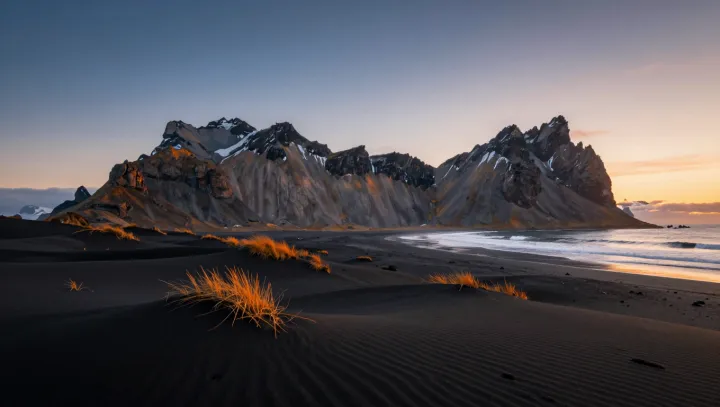
Black sand at the foot of glowing peaks is not a coincidence; it is the same volcanic engine caught at two stages of its cycle. Molten rock, or magma, rises along fractures, cools as basalt or andesite, and stacks into thick volcanic edifices that push upward into sharp ridges and summits lit gold by low sun.
The strange part is that the very rocks lifted skyward are already being dismantled. Thermal stress, frost wedging, and chemical weathering attack crystal bonds in plagioclase, pyroxene, and olivine, breaking the volcanic pile into blocks, then pebbles, then sand-sized grains rich in iron and magnesium that darken as surfaces oxidize and roughen.
Wind then becomes an efficient sorting machine. Light ash and pumice fragments can travel far, while dense basaltic grains, with higher bulk density and distinct magnetic properties, settle into dunes near the source, their black surfaces absorbing sunlight that makes the adjacent peaks appear even more golden by contrast in the same frame.