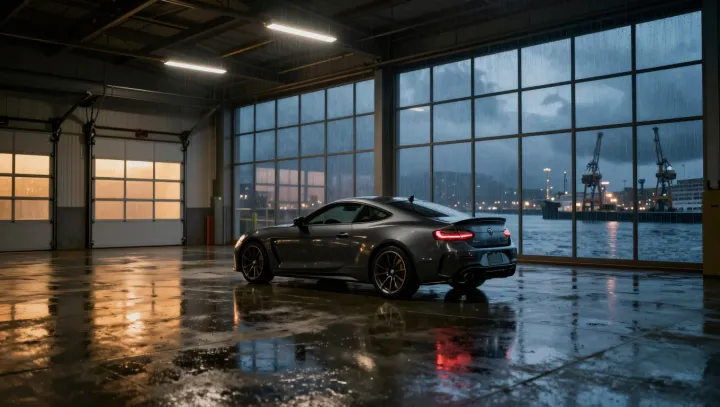
A shallow puddle on a studio floor often tells the truth faster than a wind tunnel. In its mirror, the car’s reflection either flows in a single unbroken ribbon or fractures into kinks and steps that betray subtle misalignments. No pressure sensor or strain gauge is needed; the optics do the talking.
Design chiefs argue that aerodynamics is first a story about surfaces, and only then about coefficients like drag and lift. When a car creeps past bright overhead strips, the light bands sliding along the sheet metal act as a moving contour map, exposing panel gap variation, torsional twist and tiny discontinuities that provoke boundary layer separation. If a highlight suddenly jumps, air will too.
Engineers know that wind tunnels, with fixed ride height, fixed yaw angle and tightly controlled Reynolds number, can hide sins created later in stamping, welding and assembly. So studios flood floors to a few millimeters, polish clearcoat to a near-specular finish, then watch how reflections bend around the A‑pillar, mirror housing and rear quarter. Where the image warps or breaks, they infer turbulence, vortex shedding and added drag, long before a prototype earns a slot in expensive tunnel time.