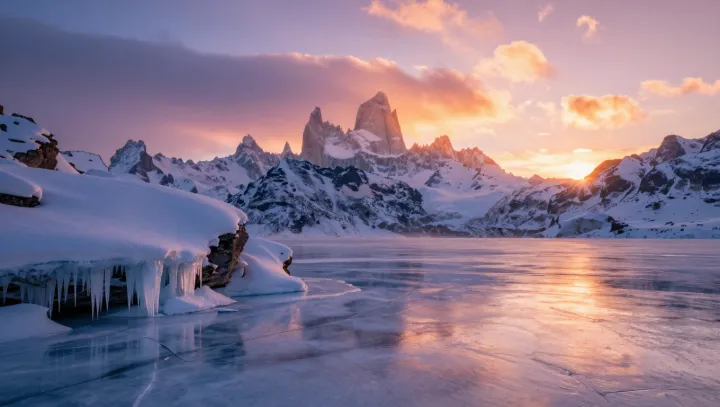
Cold ice, oddly, can look hot. Near a low winter sun, sheets of frozen water flare with gold at one angle and violet at another, while their temperature holds far below the melting point. What changes is not thermal energy in the ice but the spectrum and geometry of the light field, filtered first by the atmosphere and then by the ice surface itself.
Key here is that the sky is not one color. Rayleigh scattering in air strips more blue from sunlight along long slant paths, so the direct solar disk shifts toward red and orange while the dome of sky still carries shorter wavelengths and even faint violet. Ice then acts as a selective mirror and prism. Its flat facets and micro-roughness impose Fresnel reflection and refraction, redirecting those already separated wavelengths toward an observer at specific viewing angles.
So the warmth is an illusion. The ice only re-routes photons whose energy content was set when they left the solar photosphere, while its own molecular lattice stays locked in a rigid, sub-freezing configuration. Where the surface is smoother, specular reflection throws concentrated gold streaks. Where it is frosted or porous, multiple internal reflections and partial absorption bias the emerging mix toward cooler violet and blue, painting a temperature-agnostic glow across the frozen ground.