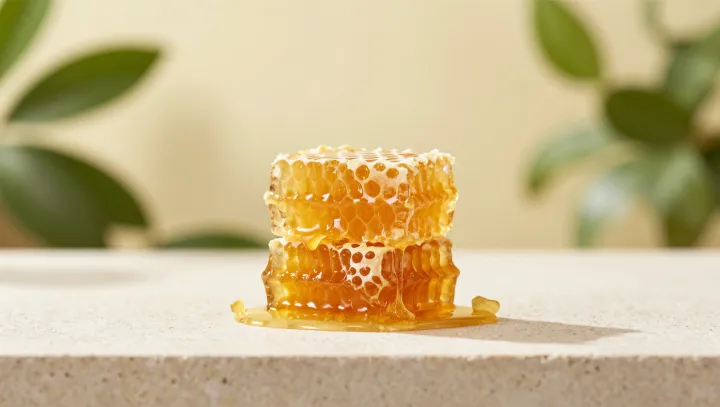
Honey is greedy. It hoards order inside chaos, and that hidden order starts in the hexagonal packing that lets sugars and water crowd together with almost no wasted space. That dense microstructure raises viscosity and keeps molecules locked in slow motion, so under gravity the liquid yields not as random drops but as those familiar, unbroken golden sheets that pour from a spoon like a drawn curtain.
Flavor gets louder when structure stays uneven. Drizzling over hot toast exploits the same viscoelastic behavior and surface tension that control the sheeted flow, forcing honey to land in ridges, beads, and tiny pools instead of a uniform film. Those thicker pockets heat more slowly, preserve volatile aroma compounds, and dissolve in bursts, while the dry bread between them continues to caramelize, giving sharper Maillard notes that contrast with the sweet streaks.
Uniform spreading, by contrast, is a flavor tax. A thin, continuous layer maximizes contact area, speeds heat transfer, and flattens the gradient between sticky and crisp, so sucrose and fructose diffuse more evenly into the crumb and every bite trends toward the same mild sweetness. A quick drizzle keeps the honeycomb physics intact on the plate: concentrated, lumpy, and slightly unstable, just enough to make each mouthful feel like a new event.