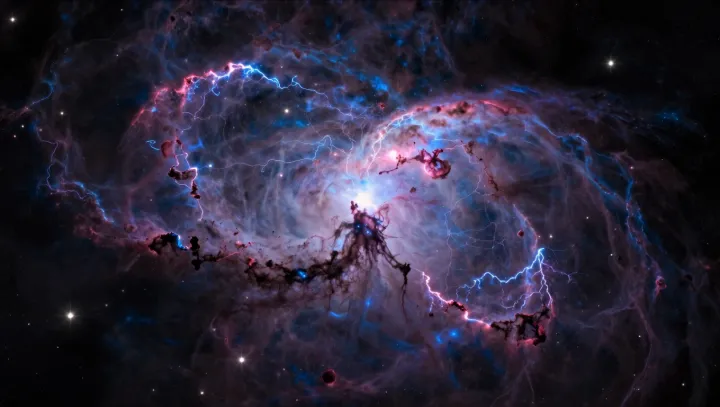
Darkness is a poor indicator of power in space. A frigid molecular cloud, packed with hydrogen molecules and dust grains just a few tens of degrees above absolute zero, can sit unseen until massive nearby stars switch on and strip away its anonymity with light and force.
The key transformation is brutally simple. Intense ultraviolet radiation from hot O‑type and B‑type stars ionizes the cloud surface, carving an H II region where electrons tear free from atoms and gas pressure soars. At the same time, high‑velocity stellar winds ram the cloud, driving a shock front that compresses some pockets while shredding others, so ridges appear where resistance is strongest and material piles up along the advancing front.
Those sharp blue‑purple edges are not decorative; they are diagnostics. Ionized hydrogen emits in the blue‑violet part of the spectrum, while scattered starlight off fine dust grains adds a cooler tint, so imaging in narrowband filters isolates knots, pillars, and ripples that mark density gradients and magnetic field guidance. Within the compressed knots, gravitational collapse can ignite new stars, turning the cloud from passive backdrop into an active factory whose sculpted profile simply exposes where radiation pressure, gas dynamics, and self‑gravity are locked in contest.