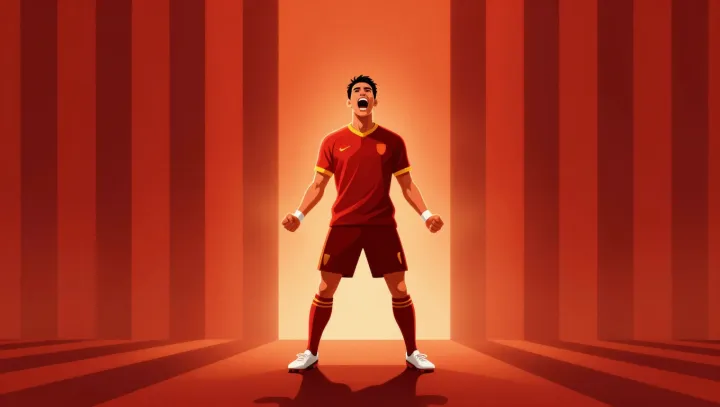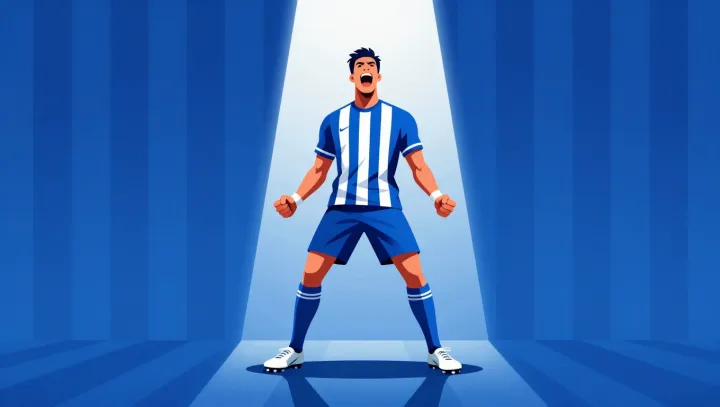
A still frame lies. Or it would, if sports artists did not rewrite it. A raw celebration is chaos, but on paper it becomes an edited signal, stripped of noise and tuned for legibility in a single glance.
The best illustrators insist that emotion is not in the face first; it is in the kinetic chain. They read hip rotation, scapular tilt and center of mass as if scanning a motion-capture rig, then exaggerate just enough to clarify intent. A clenched jaw may stay small, while a splayed hand, off-balance lean or locked knee gets pushed to the edge of anatomical plausibility, still anchored by real joint articulation and muscle tension.
Personality, they argue, hides in asymmetry. A swaggering forward gets a loose wrist, a slightly open chest, a delayed weight transfer that suggests he expects applause. A more introverted player is drawn with compact elbows, toes gripping the turf, gaze pulled inward. Direction of movement is encoded through gesture lines and negative space: the spine as a vector, the trailing leg as drag, the shirt ripple as airflow diagram, all echoing basic biomechanics and center-of-gravity physics.
What viewers call instinct is usually learned shorthand. Years of exposure teach the eye that a raised arm plus arched back equals triumph, while a half-crouch with inward shoulders signals relief or disbelief. Sports artists leverage that shared visual vocabulary, compressing an entire run, jump and shout into one readable stance, so a single pose can carry the weight of the match.