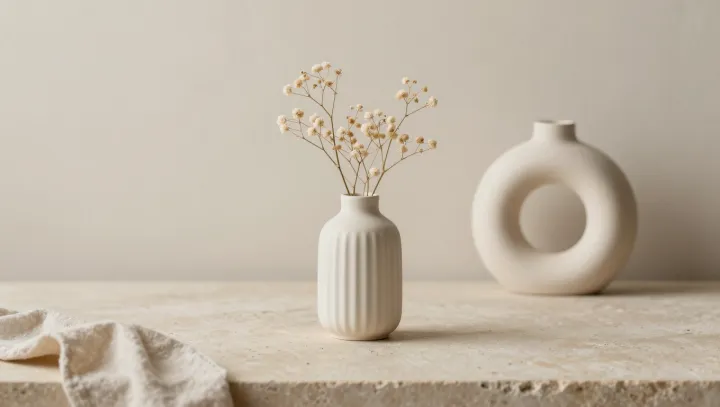
Bare walls do not make a calm room; calibrated texture does. A few rough ceramic vases and brittle dried stems act as visual filters, interrupting the hard lines that otherwise bombard the visual cortex with high contrast edges. Vision science shows that the brain spends heavy metabolic resources on edge detection and figure–ground separation, especially in spaces packed with small, glossy, competing objects.
Minimalist rooms often fail when they are too smooth, forcing the eye to keep scanning blank planes in search of anchors. Coarse clay and fragile petals offer those anchors with minimal data. Their matte surfaces dampen specular reflection, lowering luminance contrast and cutting the number of micro highlights the retina must encode. Limited, desaturated color palettes further reduce the load on chromatic processing pathways, so attention can rest rather than keep reallocating.
The effect is measurable, not mystical. Studies of attentional control link reduced stimulus density to lower cognitive load and more stable working memory performance. A small cluster of vases and dried flowers creates one coherent gestalt unit instead of dozens of separate cues, trimming the scene’s entropy. In that quieter field, the brain spends less time on visual triage and more time on whatever focus the room was meant to protect.