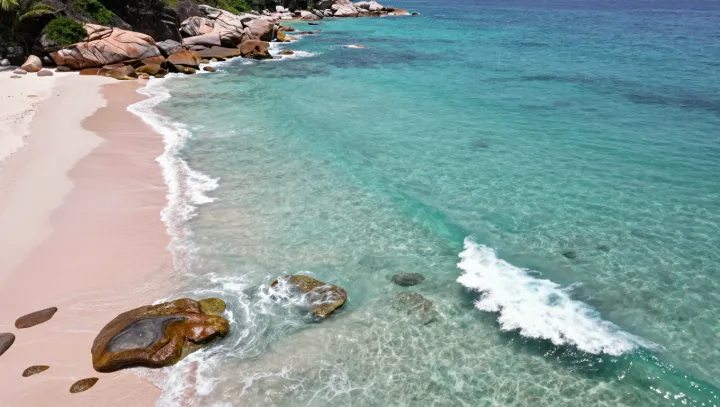
Soft turquoise water is a strict editor. Along the swash zone, each small surge runs a quiet sorting test on every grain it touches, applying shear stress, drag and lift in a pattern that repeats thousands of times per tide, until order appears where chaos once seemed guaranteed.
The odd truth is that the calmest surf can be the most selective. During uprush, faster, slightly deeper flow suspends lighter quartz and carbonate grains, while denser pink fragments of foraminifera or feldspar stay closer to the bed, responding differently to the same hydraulic gradient. As the wave thins and reverses, boundary layer flow weakens, Reynolds numbers drop, and only the heaviest or largest grains fall out first, locking into place near the waterline while finer, paler particles are carried a little farther seaward or landward before settling.
What looks like a single blur of foam is actually a repetitive conveyor. Every run-up and backwash acts as a small-scale sediment classifier, exploiting differences in grain diameter, sphericity and mineral density. Over countless cycles, that differential settling concentrates the rose-tinted grains into a narrow band, so the beach becomes a visible record of granular segregation, written one wave, one grain, one muted pink glint at a time.