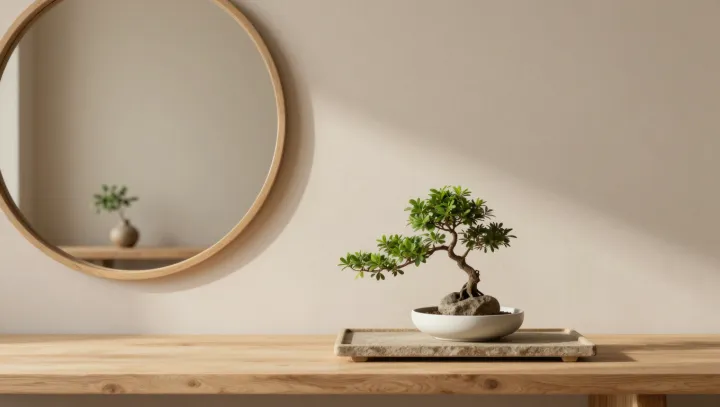
A shallow bowl with a bonsai and one rough stone does more psychological work than an entire shelf of decor. Light grazes the leaf edges, the stone throws a blunt shadow, and the brain, starved of order, finally gets an easy scene to process. That simplicity is not aesthetic fashion; it is a direct intervention in sensory load and stress physiology.
The bold claim is this: fewer objects mean less neural effort, and the numbers back it. Experimental setups using functional magnetic resonance imaging show that cluttered visual arrays trigger higher activity in the visual cortex and prefrontal cortex, regions tied to cognitive control and decision making, while stripped‑down arrangements reduce that activation and shorten reaction times in attention tasks. When the brain faces a tiny tree, a single stone, and a clean background, edge detection, figure–ground segregation, and pattern recognition run with minimal conflict, which lowers the demand on working memory and narrows the stream of incoming noise.
Even more counterintuitive is that such a small composition can behave like a compact nature dose. Research on attention restoration theory indicates that exposure to coherent natural forms, even in miniature, reduces heart rate and dampens autonomic arousal compared with abstract or busy interiors. The bonsai provides fractal branching that matches statistical patterns often seen in natural environments, while the solitary stone acts as a clear anchor point, giving the orienting reflex a single, stable target. With fewer competing stimuli, the amygdala receives less ambiguous input, the hypothalamic–pituitary–adrenal axis eases its output, and stress becomes a problem of physics and perception rather than of willpower.