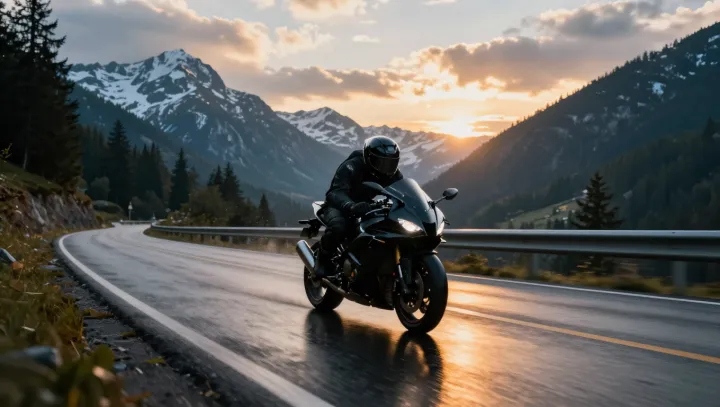
Rain turns a routine 60 mph cruise into something your nervous system flags as hostile terrain. Wet tarmac cuts tire friction, amplifies tiny slides, and throws shimmering reflections across the visor, so the same number on the speedometer now rides on a noisier signal channel.
What feels wild is not the speed itself but the mismatch between your sportbike’s potential and the brain hardware trying to track it. The vestibular system in your inner ear, tuned to angular acceleration, suddenly competes with blurred visual flow and jittering proprioception from wrists, knees and neck muscles clamped against the tank. Short micro-slips that traction control smooths out still register as abrupt changes in yaw and roll, so cortical circuits trained to predict grip from dry-road mileage keep throwing error signals: something is off, slow down, this could spike into a highside.
The paradox is that your eyes now scream faster while the bike might actually be slower. Spray, headlight glare and a rain-streaked visor boost optic flow, the apparent rush of the road surface, which the brain often uses as a proxy for velocity when vestibular input is ambiguous. Aerodynamic crouch and stiffened posture further distort somatosensory feedback, so central pattern generators that usually automate throttle and lean must hand control back to conscious processing. That cognitive load feels like danger. The number on the dash has not changed. The noise on the channel has.