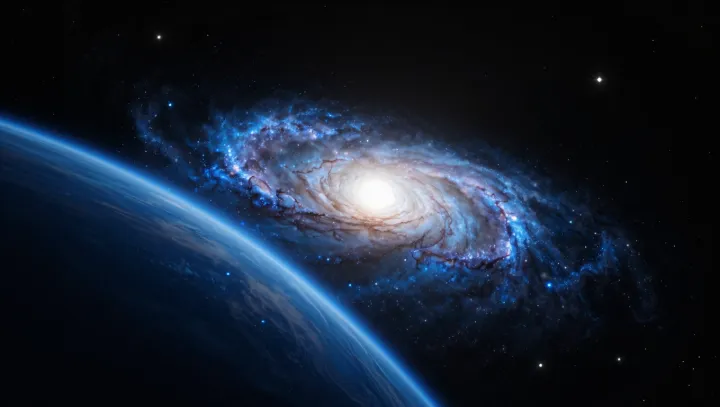
A spiral galaxy cheats your intuition. Its arms look like permanent structures, yet every individual star is in transit at hundreds of kilometers per second through the galactic gravitational potential and never locked to one bright ridge of light.
The key claim is stark. Those arms are not objects; they are patterns. Galactic dynamics calls them spiral density waves, long‑lived regions where matter is slightly compressed as it orbits. Because the disk shows differential rotation, inner stars complete circuits faster than outer ones, which should shear any fixed pattern into a featureless smear, if the arms were built from one unchanging set of stars.
Instead, the pattern behaves like a standing wave. Stars and gas drift in and out of the denser zones, slowing slightly as they enter, crowding together, then speeding up as they leave, much like vehicles piling up around a traffic jam that itself crawls along the highway. Gas clouds in these compressed regions trigger star formation, so short‑lived, luminous blue stars light the arms and make the wave visible, even while older, dimmer stars slip quietly through the structure and carry the galaxy’s mass around its center.