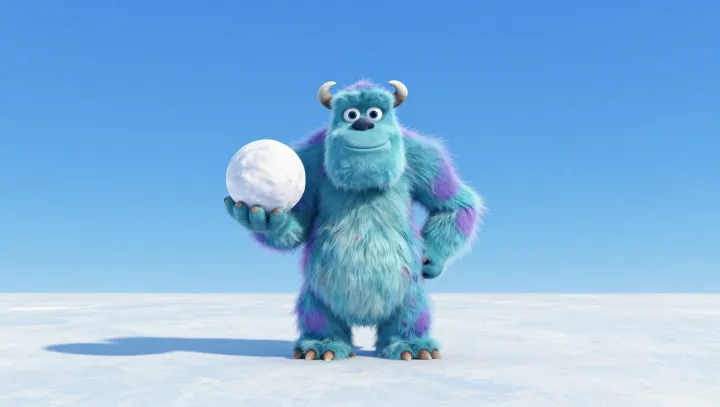
A furry CGI yeti is less a mascot than a physics device. Every hair, scarf thread, and snowflake must answer to the same equations that drive aerospace and automotive simulators, or the illusion breaks the instant the creature moves.
The core gamble is that style only works if the math is unforgiving. Studios wire the yeti into a pipeline of rigid body dynamics, particle systems, and Navier–Stokes solvers, so wind is not a guess but a solution to fluid dynamics. Each strand of fur becomes a mass–spring system under Newtonian mechanics, with parameters for stiffness, damping, and collision, then evaluated across thousands or millions of degrees of freedom until gravity, inertia, and friction settle into a believable pose.
Even the scarf is a quiet act of engineering defiance. Cloth solvers enforce constraints so fabric preserves length while responding to drag, lift, and turbulent gusts, while snowflakes run as particle simulations with forces, collision detection, and restitution coefficients tuned to feel powdery instead of metallic. What looks like one creature on screen is in practice a stack of coupled differential equations, all marching in lockstep so a single gust of digital wind ripples fur, whips fabric, and kicks up snow with the consistency of a lab experiment.