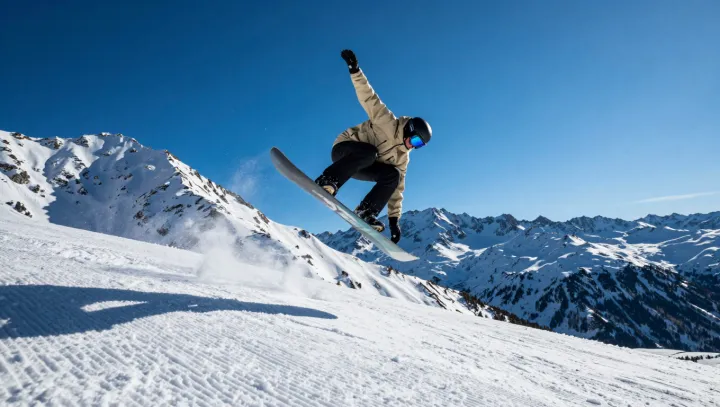
Air, not snow, does the first calculation. As the board leaves the lip, gravity, angular momentum and center of mass lock in boundary conditions that a physicist would write across pages of coupled equations, yet the rider’s brain treats them as background noise.
The blunt truth is that the body runs a faster simulator than any conscious mind. Inside milliseconds, sensory streams from the vestibular system, proprioceptors in joints and pressure receptors in the soles update an internal model of orientation and velocity, something close to a continuous Kalman filter, and that model silently revises the plan for the landing trajectory.
Muscle memory is not soft poetry; it is hard-coded optimization. Repeated jumps have tuned motor programs in the cerebellum and motor cortex so that tiny hip flexion, shoulder rotation or ankle dorsiflexion adjust angular momentum and moment of inertia just enough to speed or slow spin without blowing stability.
What looks like style is actually constraint management. Tucking the knees shortens the radius of rotation and increases angular velocity, extending the arms and board spreads mass outward and damps spin, while the gaze fixes on the horizon to stabilize the vestibulo-ocular reflex and keep balance feedback usable when the board is still blind to the snow.
The cleaner the landing, the less thinking was involved. By the time the base meets the slope and ground reaction forces spike through ankles and spine, the solution to that airborne physics problem has already been compiled, executed and forgotten, leaving only a quiet carve away from the impact zone.