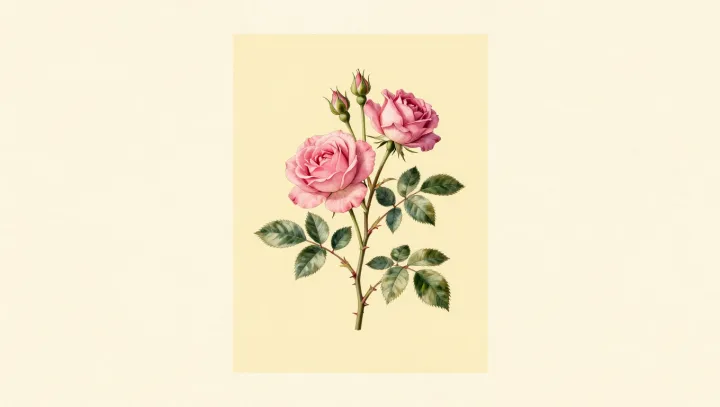
A single rose branch on paper can be more informative than a garden on a screen. That is not romanticism; it is workflow. Pigment and graphite, guided by anatomical intent, act as a manual filter that digital sensors and auto-processing rarely achieve.
The blunt fact is that illustrators are not copying appearances; they are editing structures. After studying vascular bundles, petiole insertion and sepal morphology, an artist decides which vein to exaggerate, which thorn to rotate, which petal fold to cut away in a sectional view. A smartphone sensor may capture millions of pixels, but its demosaicing and noise-reduction pipelines compress that data toward pleasing averages, flattening subtle gradients along a midrib or the tiny stipules at a node that a botanist actually needs.
Equally counterintuitive is that omission creates more information. By suppressing background foliage, reflected glare and irrelevant color shifts, a plate increases signal-to-noise in the same way a spectrophotometer isolates wavelengths. Line weight, cross-hatching and controlled wash behave like analog contrast enhancement and edge detection, but tuned to botanical function rather than to skin tones or sunset skies. The result is a hybrid document: half anatomical diagram, half field observation, in which every stroke answers a question the camera never thought to ask.