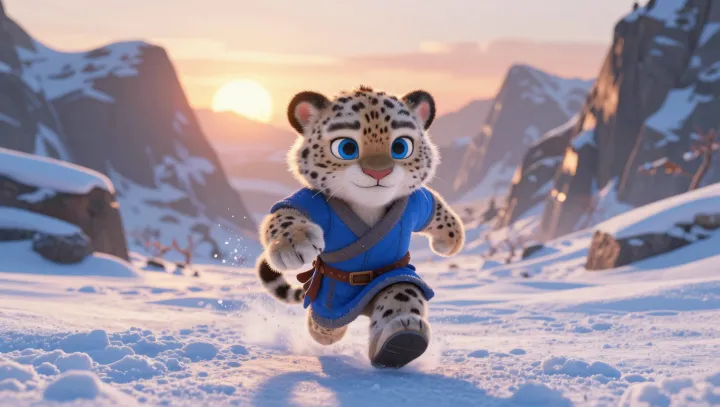
Dawn on a high pass is less a scene of struggle than a proof of design. Frosted rock, black ice, air so thin it would leave most mammals reeling, yet a snow leopard cub tears across the slope as if on dry ground. No skid marks. No visible strain. Just a pale blur threading through blue light and blown snow, every step landing with improbable certainty.
This ease is no miracle; it is engineering written into fur and lung tissue. Between each toe, dense insulating hair acts like a natural crampon, multiplying contact points and increasing the friction coefficient where paw meets ice. The broad paw pad spreads body mass, lowering pressure per square unit, so micro-irregularities in the frozen surface can be gripped instead of skated over. Claws stay semi-retracted, not for stealth but to keep them sharp for rock, while the fur layer takes over traction duty on glazed stone and wind-polished snowfields.
Even more decisive is what happens inside the chest. A snow leopard’s thorax houses enlarged nasal passages and a high-capacity pulmonary system that maximizes alveolar surface area, boosting diffusion of oxygen into blood despite low partial pressure. Hemoglobin shows strong oxygen affinity, and dense capillary networks in skeletal muscle shorten the path from arterial blood to working fibers. Combined with efficient mitochondrial oxidative phosphorylation, the cub can sustain rapid ATP production without sliding into anaerobic metabolism. The result is a sprint in air that would leave many animals heaving after a single bound, yet here it is merely a warm-up lap on the edge of the sky.
What looks like play on an icy ridge is, in effect, a quiet treaty between physics and evolution.