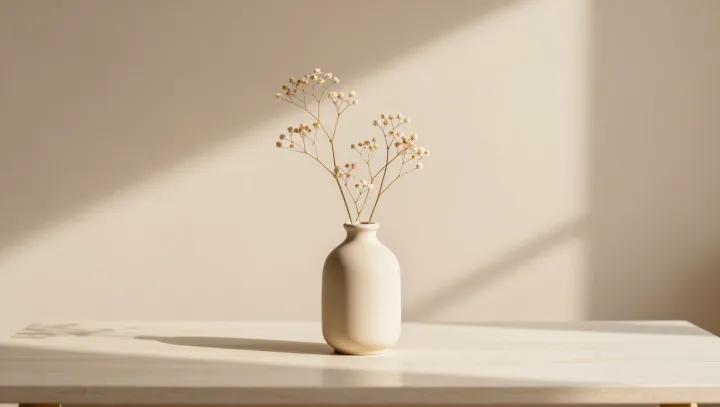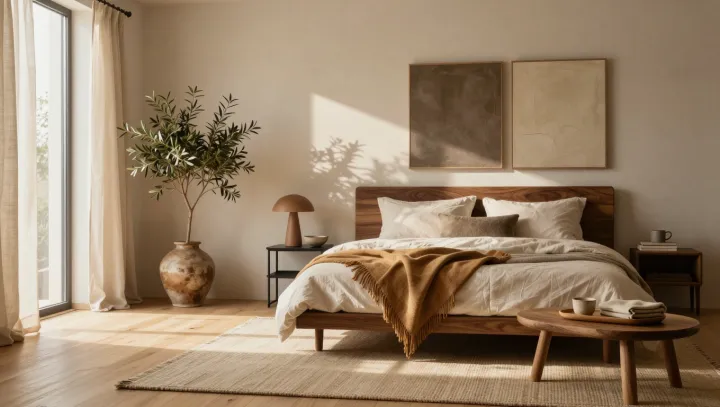
The room changes first. Across beige plaster, oak grain, and linen folds, low afternoon sun arrives with a lower correlated color temperature, and each surface returns a larger share of longer wavelengths, though no dye, finish, or fiber has altered. Nothing was replaced. What looks like a revised scheme is the eye making a revised judgment.
Warmth is partly perception. Afternoon daylight has a spectral power distribution shifted from the bluer balance often associated with higher sun, because its longer atmospheric path removes more short-wavelength light through Rayleigh scattering. The shift is modest. Yet beige is highly responsive: its restrained chroma leaves room for surrounding light to steer its apparent hue. Wood follows suit. Its pores and grain catch angled illumination unevenly, placing faint gold beside brown.
Texture gets a better stage. A broad, low source can keep shadow edges gentle while grazing across raised threads and open grain, producing local luminance contrast rather than glare that flattens small relief. Linen benefits most. Its weave makes alternating highlights and microshadows, while diffuse reflection prevents either from becoming mirror-bright. Adaptation seals it. Once the visual system sets the incoming illumination as its white point, beige's warm cast feels native rather than stained, and the room appears to gain depth at no material cost. The verdict lingers.