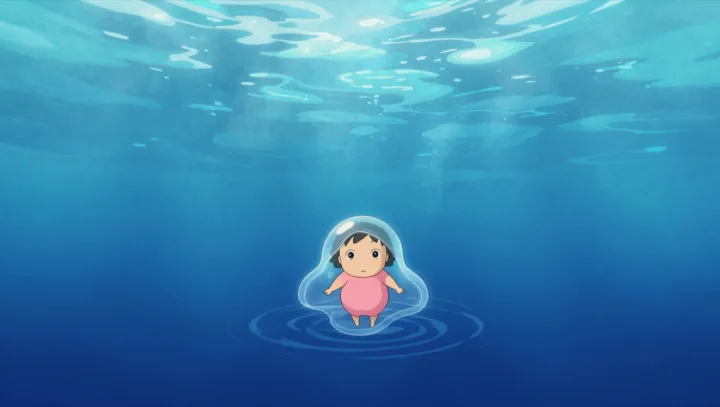
Water makes a poor window. In the rounded skin of a dome, however, Ponyo's quiet gaze swells and bends, as if the surface had briefly acquired the authority of glass; the image is not merely enlarged, but sorted into near and far by refraction.
That distortion is the point. A water dome creates an optical interface whose refractive index differs from the air around it, so incoming light changes direction under Snell's law; where the curved meniscus acts as a convex lens, rays from the face can spread across a larger apparent field. Depth does not vanish. It becomes legible through error: the eye reads enlargement, curvature, and the softened edge of the surface as signals that one space lies before another.
The effect is less innocent than it looks. Ponyo's gaze, held behind this liquid aperture, is made intimate precisely because it cannot be reached; surface tension maintains the dome's form, while focal length decides how strongly the face seems to press toward the viewer. No digital trick is needed. The water does the editing, placing a small face at the unsettled treaty between air and depth. There, sight meets resistance.