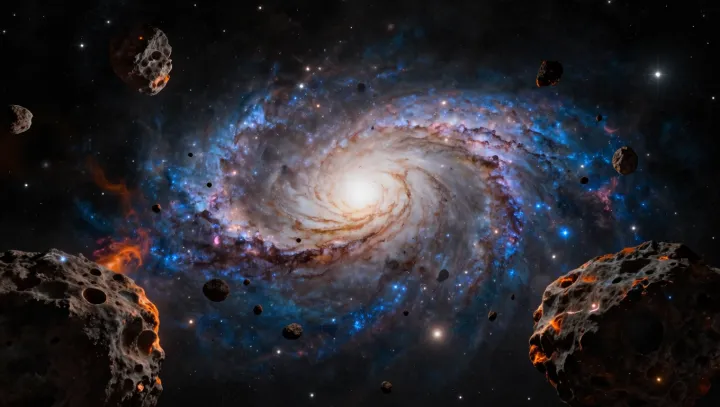
The arm is no ornament. A dust lane running along its inner edge reveals the trick: across a galactic disk, a spiral density wave can pass through gas without hauling each cloud with it, as a slow queue advances through a crowded street while individual cars enter, brake, and leave. The visible curve is a pattern, not a fixed chain of stars.
The jam is productive. Where interstellar gas enters the denser lane, shock fronts slow it and raise its density; gravitational instability can then fracture portions of the gas into molecular clouds, the cold reservoirs from which stars form. That sequence has a lag: the densest dust lanes often sit on one side of an arm, while stellar nurseries appear downstream after collapse has gained the upper hand. Young, hot stars flood nearby dust with ultraviolet radiation, so the arms advertise recent birth in blue light and glowing nebulae.
The picture resists romance. Spiral density waves are one explanation, not a universal script: some galaxies show transient arms stirred by gravitational encounters, bars, or self-gravity, while differential rotation continually threatens to wind any pattern tight. Measurements of gas velocity, stellar ages, and magnetic fields help separate a long-lived wave from a fleeting overdensity, though no single diagnostic settles every disk. Yet the recurring lesson is sharper than the postcard view. A galaxy's curved lines may mark delay, pressure, and collision--the places where motion briefly yields to creation.