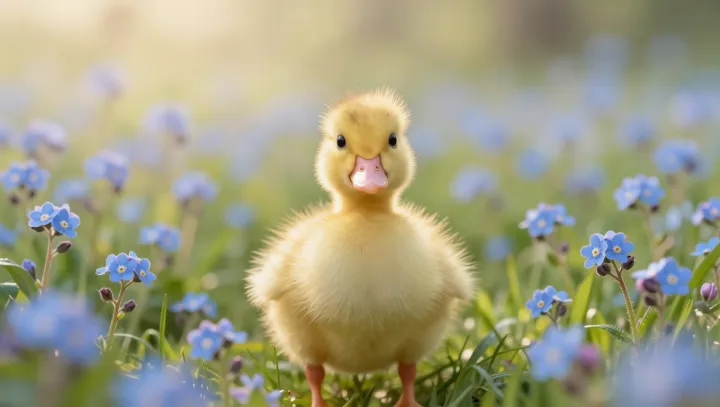
The duckling's tipped eye wins immediately. It owns the frame. That is the first misdirection. Behind it, the meadow dissolves into pale washes, a visual trick that invites the familiar claim of spring haze. Yet the softness begins in the lens, not in the grass, as a narrow depth of field holds the bird's face near the focal plane while stems and blooms surrender their edges.
That distinction matters more than it seems. Blur is not weather. With a wide aperture and close focusing distance, the zone judged acceptably sharp contracts; points outside it spread across the sensor as circles of confusion. Sensor size, focal length, and subject distance also govern the apparent extent of that blur. Photographers call the resulting rendition bokeh, though the term can flatter an effect that is, at base, optical geometry. The scene feels painted because the camera withholds detail selectively.
The image is therefore an engineered choice, not a meadow record. That is its quiet audacity. Its charm rests on a small act of exclusion: the lens privileges the duckling's angled glance and lets the meadow become color, light, and suggestion. The eye accepts this trade without complaint, reading abstraction as atmosphere and intimacy as nature. The technique creates intimacy by reducing competing visual evidence, not by documenting moisture, mist, or some seasonal veil. Nothing is wrong with the illusion. But calling it a naturally hazy field misses the sharper story, in which attention is manufactured one blurred edge at a time.