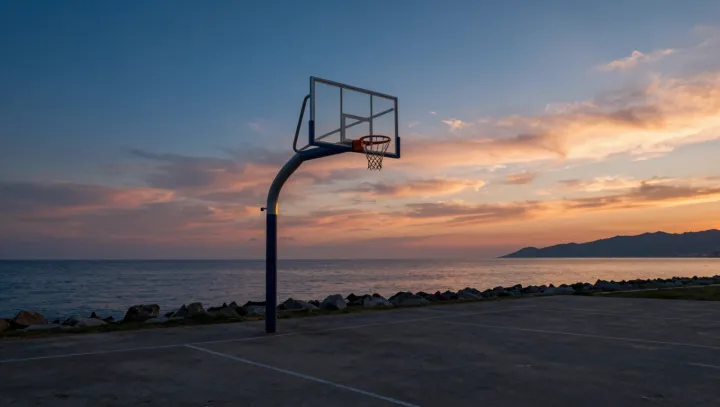
A lone hoop, cut loose from walls and framed against an open horizon, does more than simplify basketball: it turns a bounded contest into a visible measure of distance, because every pass and missed shot must cross air with no architecture to hide its path. Nothing cushions it. The court seems to spill outward.
That exposure is not sentiment; it is perceptual geometry at work. Binocular vision uses convergence and retinal disparity to estimate depth, while optic flow ordinarily lets fences, roofs, crowds, and nearby objects provide a dense field of motion cues. Strip those cues away and the eye grants unusual authority to the horizon, a reference so remote that painted lines and the small ring appear diminished beside it. Silence follows, too. Fewer reflecting surfaces reduce reverberation, leaving each bounce with less acoustic tail and making gaps between sounds feel wider. Even a routine layup can feel like a signal sent across water. The game does not become smaller. It becomes accountable. Players cannot borrow drama from an arena; bodies, ball, wind, and distance must make it. Beneath that bare rectangle, the hoop is both target and accusation, asking how much human noise can stand against so much sky.